Auto Mouse 1.3 User Guide
Auto Mouse lets you use the keyboard to perform mouse clicks, dragging and scrolling. It can also click for you after a small wiggle and a pause. You still position the pointer where you want to work; Auto Mouse takes care of the button or wheel action.
The Screen Mouse is the mouse-shaped indicator that appears beside the pointer. Its appearance shows which button or scroll direction is being used. This guide explains the three operating modes, the keyboard controls and the settings you can adjust to suit the way you work.
If you are new to Auto Mouse, start with Introduction. The Settings topics explain each option beside a numbered picture of the settings window.
Introduction
Auto Mouse is a Windows program that lets you perform common mouse actions using your keyboard, or make a click automatically after a small pointer wiggle and a pause. You can use it for everyday work such as selecting items, opening menus, dragging files and scrolling through documents.
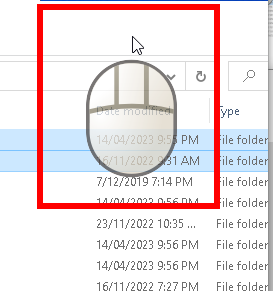
The Screen Mouse is a mouse-shaped indicator beside the pointer. It tells you when the keyboard mouse controls are available and shows the button or scroll direction you are using. You can change its size and visibility without changing the size of the normal Windows pointer.
Getting started
In General, select Smart: Let me click the mouse using the keyboard movement keys and make sure Auto Mouse is turned on. Move the pointer far enough to show the Screen Mouse, then position it over something you want to click. Press and release 1 to make a left click. You can try this on a folder or another ordinary item before using it in your work.
The default action keys are the number keys along the top of the keyboard. The settings lists call them D1, D2, D3, D4 and D5; these are different from the number-pad keys.
-
1 (D1): press to hold the left mouse button down, then release to let it go. A quick press and release makes a normal left click.
-
2 (D2): press and release to use the middle mouse button. What a middle click does depends on the application you are using.
-
3 (D3): press and release to use the right mouse button, for example to open an item's shortcut menu.
-
4 (D4) scrolls down and 5 (D5) scrolls up. Tap for individual scroll actions, or hold the key to keep scrolling. Scroll Amount on Screen Mouse controls the amount moved by each action.
To drag an item, point at it and hold 1. Keep the key held while you move the pointer to the destination, then release it to drop the item. Holding a key holds its mouse button; it does not make a series of separate clicks. You can use the same approach to select text or drag a scrollbar.
To make a double-click with a keyboard button key, press and release it twice in quick succession. These are two ordinary clicks, just as with a physical mouse. Auto Click Type changes the separate automatic-click mode; it does not turn every keyboard tap into a double-click.
While the Screen Mouse is visible, its configured action keys are used for mouse actions rather than typing into the application. When it is hidden, those keys work normally again. If you need to type numbers or work without Auto Mouse, turn it off with the default shortcut, Ctrl+Alt+A. Press the shortcut again when you want to resume.
Choose a mode
Smart: Automatically show and hide the Screen Mouse
Select Smart in General. In this mode, moving beyond the Discard Zone shows the Screen Mouse. Use the click and scroll keys while it is visible. When you stop using it, it fades away after the configured lifespan. This is useful when you want the keyboard controls to become available as you move between items.
Auto: Make a click after a wiggle and a pause
Select Auto in General. Position the pointer over the place you want to click, make a small movement in one direction and then back in the opposite direction, and leave it still. After the idle delay, Auto Mouse performs the selected click. Each wiggle prepares one automatic action; simply moving to an item and pausing does not make a click. Auto Click contains the wiggle settings, the mouse button and the choice of a single, double or triple click. Clear Require wiggle gesture there if you prefer the original movement-and-pause behaviour.
Manual: Show and hide the Screen Mouse with a key
Select Manual in General. In this mode, you decide when the keyboard mouse controls are available. Press the activation key to show the Screen Mouse, use the action keys, then press the activation key again to hide it. A brief SCREEN MOUSE ON or SCREEN MOUSE OFF message confirms the change. Unrelated keys, including ordinary typing, navigation and function keys, leave it visible. Use the activation key to hide it; turning Auto Mouse off or exiting also stops it. The default activation key is F1. This can be useful when you want to make careful pointer movements without automatically bringing up the controls.
Pausing and returning to your work
The global toggle shortcut is Ctrl+Alt+A by default. It turns Auto Mouse on or off while you stay in the application you are using. A brief AUTOMOUSE ON or AUTOMOUSE OFF message confirms the change. You can change this shortcut in General. Turning Auto Mouse off also releases any simulated mouse button you are holding.
Close hides the settings window and leaves Auto Mouse running in the Windows notification area. To open the settings again, right-click its notification icon and choose Options. To stop the program completely, choose Exit from that menu. Your settings and Total Clicks Saved are remembered between sessions. Auto Mouse starts turned on when you launch it again.
You can adjust the controls as you become familiar with them. Screen Mouse contains the keys, size, lifespan and scroll amount. Advanced contains timing, visibility and sound settings. Discard Zone controls how much movement is ignored before an automatic action is activated. The following topics explain these settings in more detail.
Settings
The settings window is where you choose how Auto Mouse works. Right-click the Auto Mouse icon in the Windows notification area, beside the clock, and choose Options. Windows may place the icon inside its hidden-icons area.
Changes are saved as you adjust the controls, so there is no Apply or Save button. You can change a setting, return to your application and try it. The values in the pictures are examples from a saved profile; they do not have to match your own settings.
General selects the operating mode and the options used throughout the program. It also contains the global shortcut for turning Auto Mouse on and off.
Screen Mouse selects the activation key, the three mouse-button keys and the two scroll keys. You can also adjust the Screen Mouse's lifespan and size, and choose how much each scroll action moves.
Auto Click selects the button and the number of clicks made in Auto mode. It also lets you require a wiggle before clicking and adjust the movement distance and time allowed for the gesture. These settings are used only when Auto is selected in General.
Advanced contains the timing and appearance adjustments. Its Sound Settings group lets you choose a separate sound for each button and scroll direction, preview the sounds, or turn them off.
Discard Zone contains the large circle selector. Use it to choose how much small pointer movement Auto Mouse ignores in Smart mode, or in Auto mode when the wiggle requirement is turned off.
Turn On and Turn Off change whether Auto Mouse is active. You can use the toolbar, the notification icon menu or the global shortcut. Close hides the settings window but leaves Auto Mouse in its current on or off state. Choose Exit from the notification icon menu when you want to quit completely.
Reset To Default restores the interaction settings after you confirm the reset. It applies to the settings across the tabs, so use it when you want to start again with the standard configuration. Your Total Clicks Saved is kept.
The ? help icon opens the local Help File at the topic for the selected tab. You can read the manual without opening a web browser or connecting to the internet, then use its contents to move to another topic.
General Settings
General is where you choose one of the three operating modes and set the options you use throughout Auto Mouse. Choose the mode that suits how you want to work, then use Screen Mouse or Auto Click to adjust its controls.
The toolbar shows Turn Off when Auto Mouse is active, and Turn On when it is turned off. The Total Clicks Saved banner remains visible above the tabs. Sound selections are on Advanced, under Sound Settings.
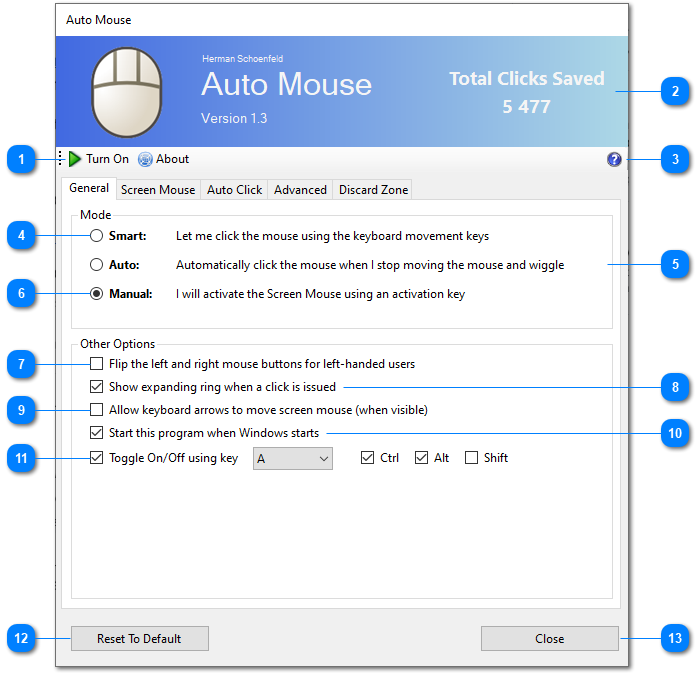
[1] Turn On / Turn Off
Use this command to pause or resume Auto Mouse without exiting the program. Turning it off stops automatic actions and releases any simulated button that is held down. This is useful when you want to drag, scroll or type using your usual controls for a while. The same change can be made from the notification icon menu or the global shortcut. A brief AUTOMOUSE ON or AUTOMOUSE OFF message confirms the new state.
[2] Total Clicks Saved
This is the running total of completed mouse clicks Auto Mouse has simulated for you. A single click adds one, a double-click adds two and a triple-click adds three. A completed keyboard drag also adds one when its held button is released. Physical mouse clicks and scrolling do not increase the total. The number is saved between sessions and uses spaces to separate thousands, for example 1 000 000. Reset To Default keeps this total, so changing your interaction settings does not erase it.
[3] Open Help File
Click the ? icon to open the local Help File. The manual opens at the topic for the tab you are viewing, so you can read about that group of settings straight away. Use the help window's contents and links to read other topics. The Help File is supplied with Auto Mouse and can be read without an internet connection.
[4] Smart mode
Select Smart: Let me click the mouse using the keyboard movement keys. In this mode, moving the pointer beyond the Discard Zone shows the Screen Mouse and makes the configured click and scroll keys available. Point at an item, then press and release its click key. Hold the key while moving the pointer when you want to drag. After inactivity, the Screen Mouse fades away and the keys return to their normal use. Adjust this delay with Lifespan on Screen Mouse.
[5] Auto mode
Select Auto: Automatically click the mouse when I stop moving the mouse and wiggle. Position the pointer over the item you want, move a short distance in one direction and then back in the opposite direction, and leave it still. After the idle duration, Auto Mouse performs the click selected on Auto Click. Each accepted wiggle prepares one action, so an ordinary move and pause does not click by itself. Auto Click lets you adjust the gesture or turn its requirement off. Advanced controls the idle duration. The Screen Mouse is not used to issue these automatic clicks.
[6] Manual mode
Select Manual: I will activate the Screen Mouse using an activation key. Press the activation key to show the Screen Mouse and use its click and scroll keys. Press it again to hide the Screen Mouse and return those keys to ordinary typing. SCREEN MOUSE ON and SCREEN MOUSE OFF messages confirm these changes, separately from the global AUTOMOUSE messages. Unrelated keys, including ordinary typing, navigation and function keys, leave it visible. Turning Auto Mouse off or exiting also hides it. The normal inactivity lifespan does not hide it in this mode. Choose the activation key on Screen Mouse; the default is F1.
[7] Flip mouse buttons
This option swaps the Windows left and right mouse-button mapping for left-handed use. It affects the normal mouse-button arrangement in your applications as well as the actions you use with Auto Mouse; the middle button is unchanged. If left and right actions seem reversed, check this option before changing the key assignments. Leave it clear when you want the usual left and right arrangement.
[8] Expanding rings
When this option is selected, an expanding ring marks the position of a simulated click. It gives you visible confirmation of where the click was made, which can be useful when working with small controls or when sounds are turned off. The ring's size is set on Advanced. Clear this option if you prefer to work without the extra visual feedback.
[9] Keyboard arrows
Allow the arrow keys to move the pointer while the Screen Mouse is visible and no mouse button is being held. This lets you make pointer adjustments from the keyboard before using a click key. Use your usual pointer movement when dragging with a button held. While the arrows are controlling the pointer, they do not perform their usual action in the current application. Hide the Screen Mouse or turn Auto Mouse off when you want the arrows to work normally.
[10] Windows startup
Select Start this program when Windows starts if you want Auto Mouse to launch when you sign in to Windows. You do not have to open it manually each time. Clear the option if you prefer to start it only when needed. Closing the settings window leaves the program running; use Exit from the notification icon menu if you want to end the current session.
[11] Toggle On/Off using key
This shortcut turns the whole Auto Mouse feature on or off from the application you are using. Select the checkbox, choose a key and select the Ctrl, Alt or Shift modifiers you want. The default is Ctrl+Alt+A. Clear the checkbox to disable the shortcut; the key controls are then disabled too. If Auto Mouse reports a conflict with an action key or a shortcut already registered by another application, choose another combination. This global shortcut is separate from the key that only shows or hides the Screen Mouse.
[12] Reset To Default
Use this button to restore the interaction settings across the tabs to their standard values. Auto Mouse asks you to confirm before applying the reset. It is useful if you have experimented with several settings and want to start again. Your Total Clicks Saved is preserved. If you only want to change one option, adjust that control directly instead.
[13] Close
Close hides the settings window so you can return to your work. Auto Mouse stays in the Windows notification area and keeps its current on or off state. Right-click the notification icon and choose Options to bring the settings back. If you want to stop the program completely, choose Exit from that menu.
Screen Mouse Settings
The Screen Mouse is the mouse-shaped indicator beside the pointer. This tab controls when it is shown, its size and the keys used for button and wheel actions. The L, M and R on the preview identify the left, middle and right buttons.
A click key works like the corresponding physical button. Pressing the key holds the button down and releasing it lets the button go. This allows normal clicks, text selection and dragging. Scroll keys issue wheel actions and can repeat while held.
D1 to D5 in the lists mean the number-row keys 1 to 5, not the number pad. Your configured action keys are intercepted while the Screen Mouse is visible. Choose keys that suit your work, and hide the Screen Mouse or turn Auto Mouse off when you need to type those keys normally.
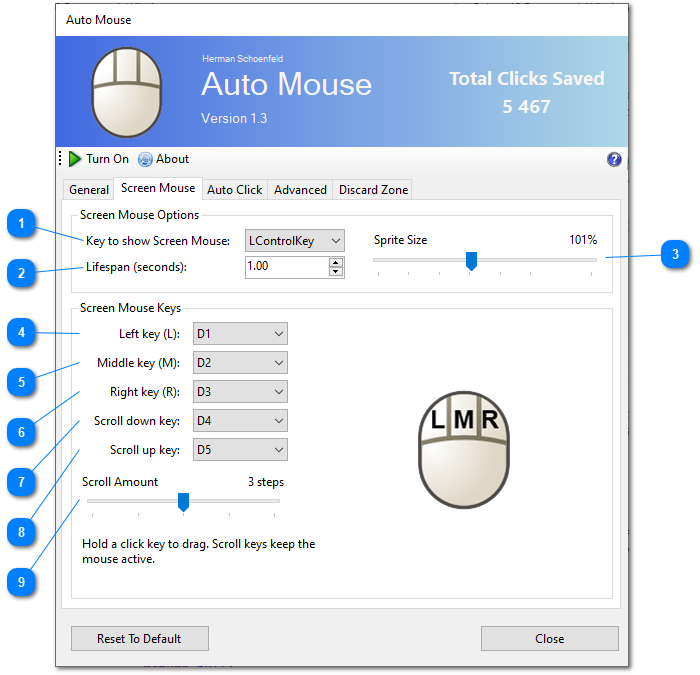
[1] Key to show Screen Mouse
Choose the key that shows and hides the Screen Mouse in Manual mode. The default is F1. Press it once to show the controls, use the click or scroll keys, then press it again to hide them. SCREEN MOUSE ON and SCREEN MOUSE OFF messages confirm the change. This setting is used with Manual in General. It is separate from the global Toggle On/Off shortcut, which pauses all mouse actions throughout the program.
[2] Lifespan (seconds)
In Smart mode, this is the period of inactivity before the Screen Mouse fades away. The default is 1.00 second. Increase it if the controls disappear before you have finished positioning or using them; decrease it if you want the keys to return to normal typing sooner. Pointer movement, clicks and scrolling renew the inactivity timer, including repeated scrolling while a scroll key is held. Holding a click key also prevents the ordinary idle fade. In Manual mode, the Screen Mouse does not fade away on idle or unrelated keypresses, including ordinary typing. Use the activation key to hide it, or turn Auto Mouse off or exit the program.
[3] Sprite Size
Move the slider to make the Screen Mouse smaller or larger, from 25% to 200%. The L/M/R preview changes immediately so you can judge the size before returning to your work. The default is 100%. A larger image can make the button states easier to see; a smaller one leaves more of the underlying work visible. This changes the Screen Mouse artwork, not the normal Windows pointer. Your selected size is remembered between sessions.
[4] Left key (L)
Choose the key for the left mouse button. The default is D1, the number-row 1 key. A quick press and release makes a left click. To drag a file, point at it, hold the key, move to the destination and release. You can also hold it while moving across text to select it. The left part of the Screen Mouse shows the pressed state while the button is held.
[5] Middle key (M)
Choose the key for the middle mouse button. The default is D2, the number-row 2 key. Pressing the key holds the middle button and releasing it lets go. The action depends on the application. Some use a middle click to open a link or use a held middle button for panning. The middle part of the Screen Mouse shows when this button is pressed.
[6] Right key (R)
Choose the key for the right mouse button. The default is D3, the number-row 3 key. Press and release it to make a right click, such as opening an item's shortcut menu. Holding the key holds the right button until you release it, which can be used for right-button dragging in applications that support it. Check Flip mouse buttons in General if the left and right actions are reversed.
[7] Scroll down key
Choose the key for scrolling down. The default is D4, the number-row 4 key. Tap the key to issue one scroll action, or hold it to repeat scrolling using the keyboard's repeat behaviour. Each action renews the inactivity timer, so scrolling keeps the Screen Mouse available. A down marker is shown while the key is held. The selected scroll sound plays once per press, even when a held key produces several scroll actions.
[8] Scroll up key
Choose the key for scrolling up. The default is D5, the number-row 5 key. Tap for one scroll action or hold the key to continue upwards. Scroll activity renews the inactivity timer and the Screen Mouse shows an up marker while the key is held. To hear the scroll sound again, release the key and press it again. The scroll-up and scroll-down keys share the Scroll Amount setting below.
[9] Scroll Amount
Choose from 1 to 5 wheel steps for each scroll action. The default is 1 step, and the setting applies to both directions. A smaller amount is useful for reading line by line; a larger amount moves through long documents more quickly. Windows' mouse-wheel preference and the application determine how far a wheel step moves the content. You can scroll while a click key is held for dragging; scrolling does not release that button.
Auto Click Settings
These settings are used when General is set to Auto. In this mode, make a small pointer wiggle over your target, then leave the pointer still. Auto Mouse makes the selected click after the idle duration. The wiggle requirement is enabled by default.
A wiggle is a deliberate movement in one direction followed by a clear movement back in the opposite direction. Both strokes must reach the minimum travel and speed within the gesture time. With the defaults, move at least 8 pixels each way at 40 pixels per second or faster, and complete the back-and-forth within 400 milliseconds. The strokes can have different lengths and do not have to finish where they started. Stop where you want the click; Auto Mouse clicks at the final pointer position after the idle delay. Each accepted wiggle prepares one selected action. An ordinary move and pause does not prepare a click.
Use Wiggle Gesture to adjust the travel, speed and timing, or clear Require wiggle gesture to use the original behaviour. With that requirement off, moving beyond the Discard Zone prepares a click when the pointer stops. You can adjust the Wiggle Gesture settings while Smart or Manual is selected, ready for the next time you use Auto. They are used only in Auto mode. The idle delay and the interval within a double or triple click are set on Advanced. These choices do not change the keyboard click keys.
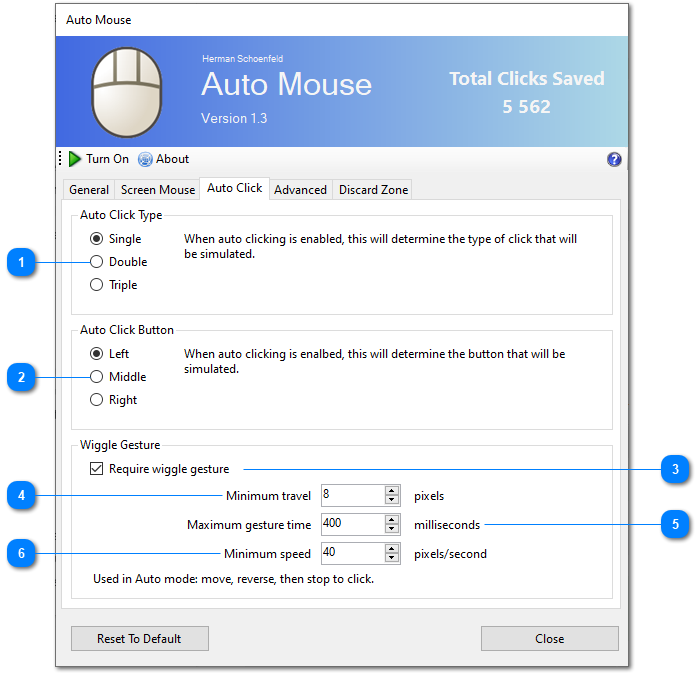
[1] Auto Click Type
Choose Single, Double or Triple for the automatic action. The default is Single. Double and Triple produce a short sequence of two or three clicks at the pointer's position; you do not have to stop the pointer separately for each click. For example, use Double where an application normally expects a double-click to open an item. Duration between clicks in double clicks on Advanced sets the spacing within that sequence.
[2] Auto Click Button
Choose whether automatic clicking uses the Left, Middle or Right mouse button. The default is Left. Left is normally used for selecting or activating an item; Right is commonly used to open a shortcut menu. Middle-button behaviour depends on the application. This choice works together with Auto Click Type, so check both before returning to your work. The keyboard button assignments on Screen Mouse are configured separately.
[3] Require wiggle gesture
Leave this option selected to require a deliberate wiggle before an automatic click. Move in one direction and then clearly back in the opposite direction. Both strokes must meet Minimum travel and Minimum speed within Maximum gesture time. Let the pointer settle where you want the click; Auto Mouse waits for the idle duration before issuing the selected action. One wiggle prepares one action, even when Double or Triple is selected. To use the original behaviour, clear this option, then move beyond the Discard Zone and pause to click. You can adjust these settings in any mode; they are used only in Auto. The distance, speed and time controls are available while this checkbox is selected.
[4] Minimum travel
Set the minimum pointer travel in each direction, in pixels. The default is 8 pixels. Both movements must reach this distance, but their lengths do not have to match. A smaller value accepts a shorter wiggle; a larger value asks for a more definite movement. Try it over an ordinary item and adjust the distance until it feels comfortable. Minimum speed separately controls how quickly you move. This distance is independent of the Discard Zone.
[5] Maximum gesture time
Set the time allowed to complete the back-and-forth movement, in milliseconds. The default is 400 milliseconds, or 0.4 seconds. A longer time gives you more time to finish both directions; a shorter time requires a quicker wiggle. Both movements must still meet Minimum speed. This is the time for recognising the gesture, rather than the pause before the click. Idle duration before auto-click on Advanced controls that separate pause.
[6] Minimum speed
Set the minimum speed for both directions of the wiggle, from 1 to 5 000 pixels per second. The default is 40 pixels per second. Lower this value to allow a gentler, slower wiggle. Raise it if you want to require a quicker movement and ignore more slow pointer adjustments. Both strokes must also reach Minimum travel and fit within Maximum gesture time. This setting does not change the pointer speed in Windows or how quickly the click sequence is played.
Advanced Settings
Advanced contains the smaller adjustments that change how Auto Mouse feels in use. Miscellaneous Settings controls timing, the expanding ring and Screen Mouse visibility. Sound Settings controls the feedback for each mouse button and scroll direction.
Change one setting at a time and try it in your usual application. If the automatic click happens too quickly, increase the idle duration. If the Screen Mouse is difficult to see, increase its visibility or adjust Sprite Size on Screen Mouse.
Each click-sound style includes a button-down sound and a button-release sound. The available styles are Soft Digital, Bit-Bop, Tick-Tock, Classic Click, Original, Glass Tap, Soft Pop, Typewriter and Pulse. Scroll sounds offer Raspy and Chop, with a different sample for each direction. Every sound list also offers None.
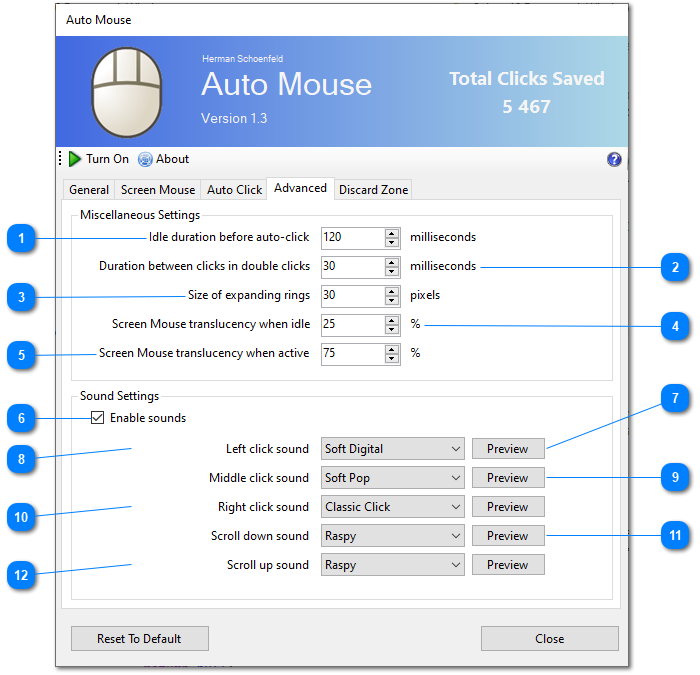
[1] Idle duration before auto-click
This is how long the pointer must remain still before Auto Mouse makes an automatic click. The value is in milliseconds; 1 000 milliseconds is one second. The default is 120 milliseconds. In Auto mode, a recognised wiggle prepares the action and this delay lets the pointer settle before it clicks. If the wiggle requirement is turned off, movement beyond the Discard Zone prepares the action instead. A longer delay gives you more time to settle on a small target; a shorter delay makes the response quicker. This setting does not control the fade-away lifespan of the Screen Mouse.
[2] Duration between clicks in double clicks
This sets the interval between the clicks of a simulated double or triple click. The default is 30 milliseconds. It changes the spacing within the click sequence, not the time you wait after moving the pointer. Use it when you need to adjust how an application recognises the sequence, and check the result in that application. Auto Click Type determines whether one, two or three clicks are made.
[3] Size of expanding rings
Set the radius of the expanding ring in pixels. The default is 30 pixels. The ring marks a simulated click and then expands away; a larger value makes the feedback more noticeable. Show expanding ring when a click is issued in General controls whether the ring is displayed. Changing the ring size does not change the area that is clicked or the size of the Screen Mouse.
[4] Screen Mouse translucency when idle
This is how visible the Screen Mouse is while it is idle. Although the setting is called translucency, a higher percentage makes the image more opaque and a lower percentage lets more of the background show through. The default is 25%. Use a lower value if you want to see more of the work underneath it, or a higher value if the idle image is difficult to find against your desktop.
[5] Screen Mouse translucency when active
This sets the Screen Mouse's visibility while you are using its keys. The default is 75%. A higher percentage makes the active image easier to see; a lower percentage shows more of the application behind it. Setting active visibility higher than idle visibility helps distinguish using a button from simply having the Screen Mouse on screen. These percentages affect appearance only; they do not alter the mouse actions.
[6] Enable sounds
Select this option to hear feedback for click and scroll actions. Clear it to mute all of that feedback while keeping your individual sound selections. You can enable it again without choosing each sound again. If you only want to silence one button or direction, leave sounds enabled and choose None in that row instead.
[7] Preview
Use the Preview button beside a sound to listen without issuing an extra mouse action. For a mouse button it plays the press-and-release pair; for a scroll direction it plays one scroll sound. Preview also works while Auto Mouse is turned off. The button is unavailable when sounds are disabled or that row is set to None. This lets you compare styles before using them during normal work.
[8] Left click sound
Choose the sound for the left mouse button. The default is Soft Digital. Its down sound is heard when the button is pressed and its release sound when the button is released, so a held drag separates the two. Use Preview to hear the pair, or choose None to keep only this button silent. The middle and right buttons keep their own selections.
[9] Middle click sound
Choose a separate sound for the middle mouse button. The default is Soft Pop. Giving it a different sound from the left button can help you recognise the action without looking at the Screen Mouse. Preview plays the selected press-and-release pair. Choose None if you do not want middle-button feedback; this does not mute the other buttons or the scroll sounds.
[10] Right click sound
Choose the sound for the right mouse button. The default is Classic Click. You can use a distinct style to make right-button actions easier to recognise, or choose the same style as another button if you prefer consistent feedback. Preview plays the press-and-release pair. None silences only this button, while Enable sounds controls all feedback together.
[11] Scroll down sound
Choose Raspy, Chop or None for downward scrolling. The default is Raspy. The sound plays once when you press the scroll-down key. Holding the key can continue scrolling, but does not keep replaying the sound; release and press again to hear another one. Preview plays the down sample once. This choice is independent of the scroll-up sound and does not change Scroll Amount.
[12] Scroll up sound
Choose Raspy, Chop or None for upward scrolling. The default is Raspy. The up sample differs from the down sample so the direction can be recognised by sound. It plays once for a press, including when that press is held to repeat scrolling. Release the key before pressing again to play it another time. Preview lets you hear the up sample without scrolling your application.
Discard Zone
The Discard Zone is the amount of pointer movement Auto Mouse ignores before showing the Screen Mouse in Smart mode. It also controls how much movement prepares another automatic click when Auto mode is used without the wiggle requirement.
In Smart mode, move beyond the zone to bring up the keyboard mouse controls. In Auto mode with Require wiggle gesture cleared, movement beyond the zone prepares the next click; leaving the pointer still then allows the idle timer to complete. When the wiggle requirement is selected, Auto Click uses its own gesture distance and time instead. The zone is a movement threshold, not a permanent area of the desktop in which clicks are blocked.
A smaller zone responds to shorter movements. A larger zone ignores more small movements but requires you to move further before another action is activated. If you are working with closely spaced controls, try a smaller zone. If small corrections keep activating Auto Mouse sooner than you want, try a larger one.
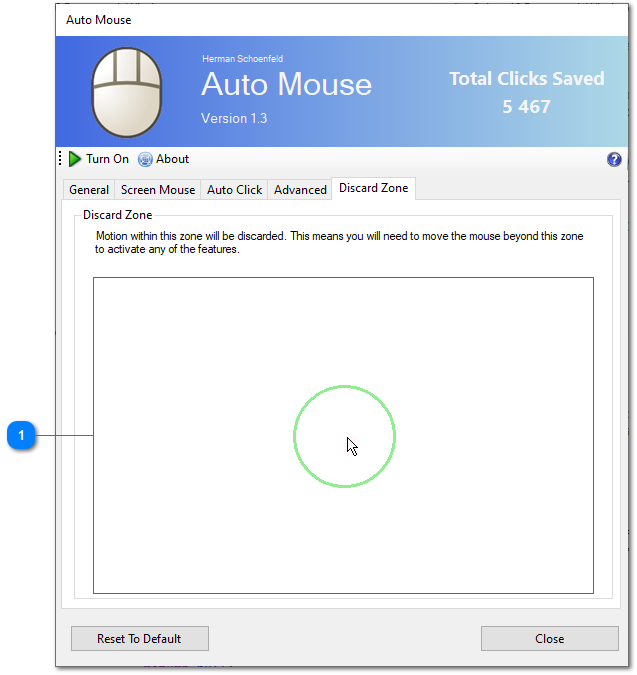
[1] Discard Zone
Move the pointer inside the large selector to preview a black circle, then click when it has the radius you want. The saved size is shown by the green circle. The default radius is 50 pixels. After choosing a size, return to your application and try a few movements and clicks. Adjust the circle until the distance feels suitable for your work. This setting changes the movement threshold; it does not resize Screen Mouse or alter how far a scroll action moves.