Enterprise Services
Monolithic Architectures
Sphere 10 builds modular monoliths with ASP.NET Core, C#, Blazor or MVC and a deliberately owned SQL data model. We structure orders, billing, scheduling and inventory into modules inside one deployable application, using EF Core, NHibernate or provider-level data access for the selected SQL Server or PostgreSQL database. The delivery has explicit module contracts, coherent local transactions, background-work ownership and a release process that operates the application as one system.
Our .NET delivery combines browser or Windows interfaces, application services, persistence and background processing in one deliberately composed host. The design keeps business decisions independent of presentation and database details, while making cross-module operations explicit. We modernise existing monoliths as well as building new systems, using working vertical slices to establish boundaries without losing current behaviour. You receive tested business workflows, a maintainable code structure and the deployment, migration and support material needed to keep the whole application moving forward.
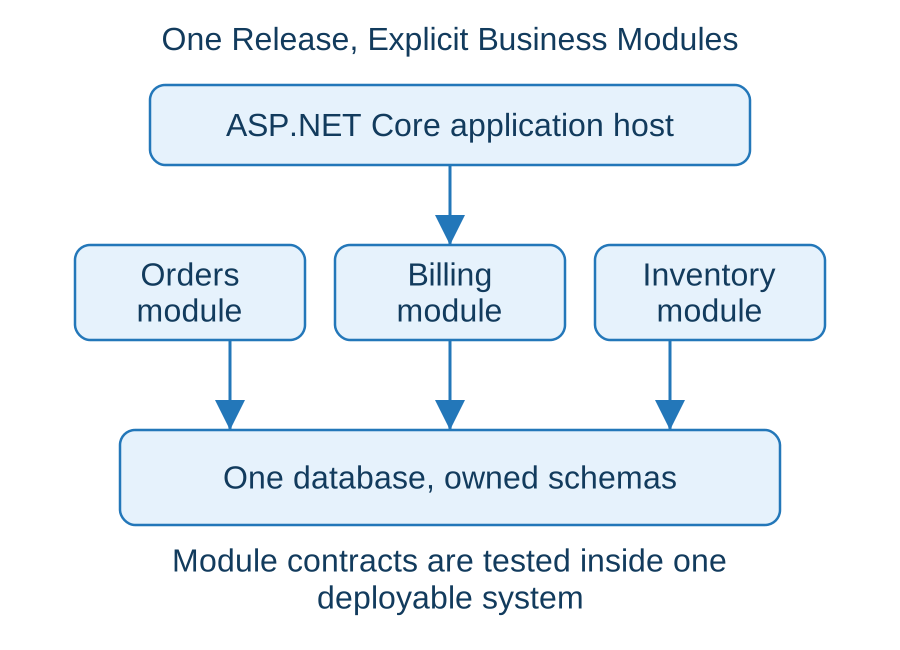
Structure the Application Around Business Capabilities
Modules own their business rules, write operations and tables or schemas. C# project/assembly references, dependency-injection registration and application-service interfaces express the permitted dependencies, while DTOs keep the public contract distinct from persistence entities. An order requests a billing decision through the billing module's interface. Shared identity, logging and configuration are composed at the host, with cyclic dependencies and cross-module table access examined in code review.
Compose One Host With Explicit Transaction Ownership
ASP.NET Core and the .NET hosting model provide application entry points, dependency injection and managed startup. We compose module services deliberately and keep request-specific state within the correct lifetime. Sphere10 Framework .Data offers IDAC and DACScope mechanisms for explicit connection and local transaction ownership where appropriate. A business operation commits the related database changes together; external calls and long-running jobs receive their own completion policy. This keeps transaction boundaries understandable and avoids holding database locks while waiting for another system.
Modernise Through Working Vertical Slices
Modernisation starts with a complete MVC, Blazor or API journey and its SQL effects. We retain its calculations and authorization behaviour while introducing an application-service contract, bounded EF Core/NHibernate loading and a versioned database migration. Background processing runs through owned .NET hosted services with explicit durable state. Each slice is checked for query counts, transaction duration and interface compatibility before another module is changed.
Accept and Support the Application as One System
Acceptance covers the integrated release, including permissions, cross-module workflows, reports, background work and recovery. We exercise realistic data volumes and simultaneous users, then retain the evidence behind agreed performance targets. The delivery includes source, build instructions, database migration scripts, operational configuration and support diagnostics. We define how your team deploys a new version, recognises an unhealthy installation and restores service. The resulting monolith has visible internal ownership and a manageable operating model as its capabilities expand.
Technologies & Integration
Discuss Your Project Back to Services
Broker Architectures
Sphere 10 builds message-driven applications with RabbitMQ, Apache Kafka, Azure Service Bus or Amazon SQS according to the delivery and ordering contract. C# services publish and consume business commands or events with explicit message identity, routing, persistence and failure handling. The architecture covers order fulfilment, document processing and integration workflows from the database change through broker delivery to the consumer's committed result.
We implement producers, consumers, persistence and operator controls together. A broker can hold and route work, but the application still owns consistency, idempotency and recovery. Our C# services make those responsibilities explicit through message identities, durable processing records and controlled retry policies. The delivery includes the message contracts, deployment configuration, observability and failure exercises required to run the system. Your team can investigate an individual operation, resume interrupted work and evolve the participating applications with a clear compatibility model.
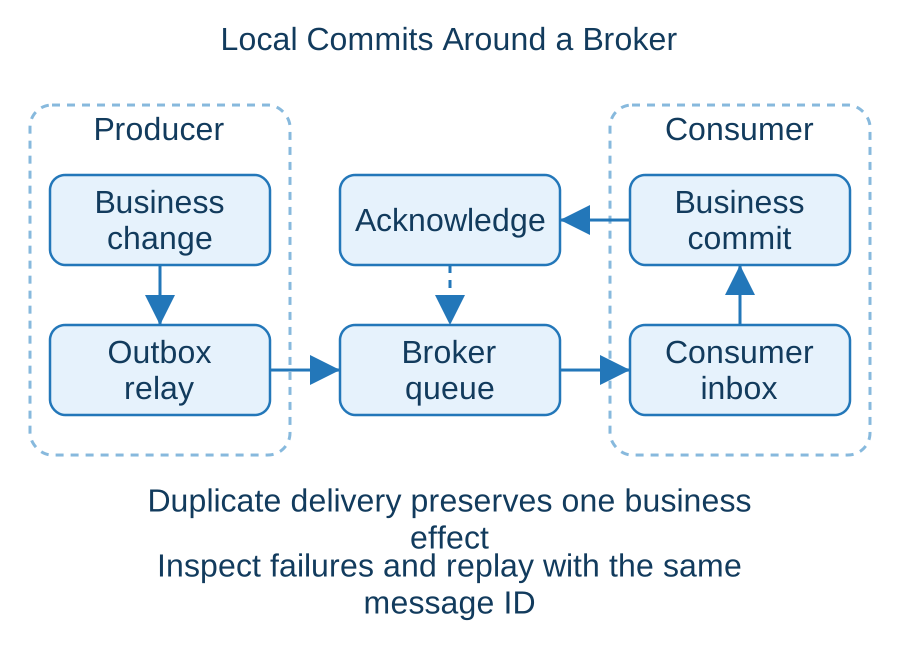
Design Message Contracts and Routing Deliberately
RabbitMQ exchanges and queues, Kafka topics and partition keys, Service Bus queues/topics, and SQS queue types have different routing and ordering models. We choose the topology around the owner of each command or event, define consumer groups or subscriptions, and version the message schema. Correlation, duplicate-detection identity and large-payload object references are part of that contract. Required ordering is stated per business key and verified with concurrent producers and consumers.
Join Database Changes to Message Delivery
We use an application outbox where a business update and an outgoing message must be recorded in one local database transaction. A relay publishes that recorded work and handles publisher confirmation. Consumers retain inbox or processing identifiers so redelivery can be recognised before repeating the business effect. Sphere10 Framework .Data supplies explicit local transaction mechanisms where selected; the outbox, inbox and retry policy are implemented and tested parts of the application. Broker acknowledgement and business completion remain separate, observable steps.
Diagram source
flowchart TD
  U["Business application"] --> A["ASP.NET Core API"]
  A --> D["SQL transaction + outbox"]
  D --> B["Service Bus or RabbitMQ"]
  B --> W["Idempotent worker"]
  W --> E["ERP or CRM integration"]
  W --> R["Retry or exception queue"]
  R --> W
classDef default fill:#eaf2ff,stroke:#2f77cb,color:#17365d,stroke-width:1.5pxMake Backlog and Failure Operable
The operating configuration defines RabbitMQ prefetch and manual acknowledgements, Kafka consumer offsets and lag, Service Bus locks and dead-letter handling, or SQS visibility and redrive policy. .NET worker concurrency follows downstream capacity, with durable retry decisions and inspected poison messages. Dashboards join queue or partition backlog, oldest work, consumer throughput and business-operation failures. A replay procedure states which identifier and recorded outcome prevent a repeated delivery from repeating its effect.
Prove the Gaps Between Every Durable Step
Acceptance deliberately interrupts the path between database commit, publication, consumer processing and acknowledgement. We verify that a restarted relay republishes safely and a redelivered message does not duplicate a payment, reservation or other business action. Load tests include a slow consumer and a temporary dependency outage. The handover contains contract definitions, topology configuration, deployment instructions, operational dashboards and recovery exercises. It equips your team to support the complete distributed workflow, including work that is delayed, rejected or awaiting investigation.
Technologies & Integration
Discuss Your Project Back to Services
Fast SQL Databases
Sphere 10 tunes SQL Server, PostgreSQL, MySQL and embedded SQLite together with the C# application using them. We investigate transaction-heavy services, ingestion and reporting through actual query plans, waits, locking, I/O and application call counts. EF Core, NHibernate and direct ADO.NET paths are inspected at the generated SQL boundary, with before/after results tied to representative data, concurrency and correct business outcomes.
We examine execution plans, indexes, locks, round trips, object loading and data movement together. A slow screen may need a narrower projection; an import may need better batching; a report may need a different aggregation or storage strategy. Our BlockchainSQL product provides a concrete reference for Bitcoin ingestion and SQL-facing analysis. We bring that end-to-end perspective to your database, then deliver measured changes, regression checks and operational evidence your team can use to maintain the improvement.
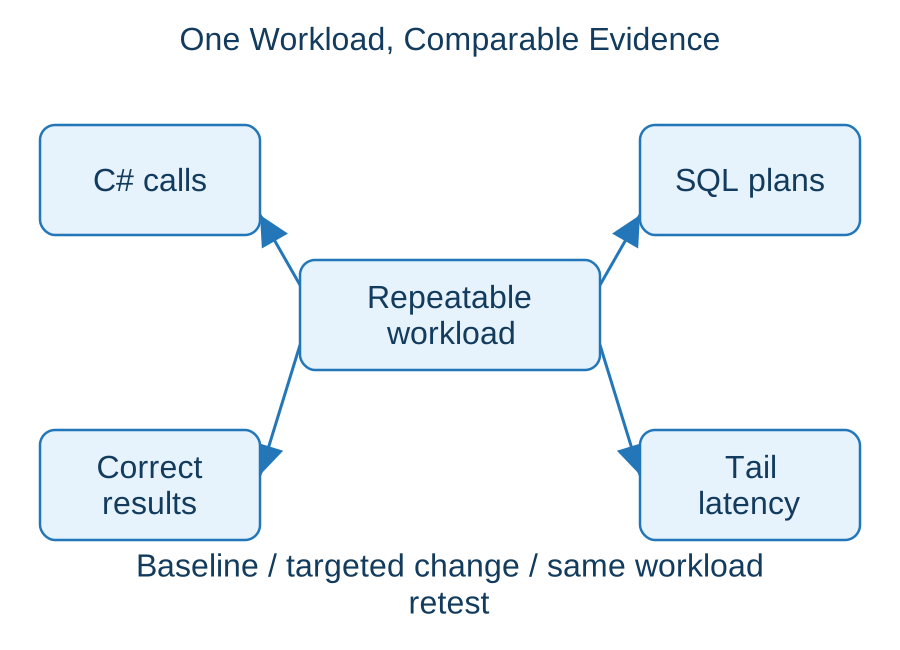
Find the Expensive Work Before Changing the Design
SQL Server Query Store and actual execution plans expose changing plans, expensive queries and workload variation; PostgreSQL EXPLAIN/ANALYZE and statement statistics show estimates, buffers and execution work. MySQL plan and Performance Schema evidence is selected for its engine, while SQLite query plans and file concurrency are examined in the embedded workload. We correlate that evidence with parameters, connection use and .NET request traces before prioritising an index, query or application change.
Optimise Queries, Indexes and the Application Contract
We shape queries around the result a caller needs, including filtering, ordering, pagination and aggregate calculation. Index choices account for selectivity, joins and write cost rather than accumulating speculative indexes. In C# applications, we inspect generated SQL, entity loading and projection boundaries so object mapping does not hide repeated database calls. Sphere10 Framework .Data IDAC and SQL-builder abstractions are examined against the selected provider; batching and command execution remain explicit choices verified on the actual engine.
Engineer Ingestion and Concurrency as Complete Workflows
For imports, SqlBulkCopy on SQL Server or Npgsql COPY on PostgreSQL can provide a deliberate bulk path after parsing and validation. We tune batch and transaction size with log/WAL growth, lock duration, restart checkpoints and duplicate handling in view. Concurrent updates receive an explicit isolation and retry policy. Reporting changes such as filtered or covering indexes, precomputed aggregates or partitioning are evaluated against their write and maintenance cost.
Accept the Improvement and Keep It Observable
We rerun the same workload against the changed system and compare both performance and results. Totals, ordering, duplicates and transactional behaviour are checked alongside timing. The delivery records the query and schema changes, configuration assumptions and test data characteristics behind the improvement. We provide repeatable benchmarks, deployment and rollback instructions, and monitoring recommendations that detect regressions. Your team receives evidence of the achieved behaviour under stated conditions and a clear way to evaluate future changes against that baseline.
Technologies & Integration
Discuss Your Project Back to Services
Cloud-Based Solutions
Sphere 10 delivers .NET cloud applications on Azure App Service, Azure Container Apps or AWS ECS/Fargate, with virtual machines or Kubernetes selected where their operating model fits. SQL Server/PostgreSQL databases, Azure Blob Storage or S3, and Service Bus or SQS are integrated as owned data and work boundaries. The delivered solution includes identity, configuration, release automation, useful telemetry and a tested recovery procedure for the business service.
Our .NET delivery covers the application and its environment together: hosted services, persistence, configuration, deployment automation and observability. We use cloud capabilities where they simplify a defined responsibility, then make the remaining application responsibilities visible. A managed database still needs a data model, migration plan and tested recovery procedure. You receive a working environment, repeatable releases and an operating handover that explains how to recognise failure, restore service and evolve the workload without depending on undocumented setup.
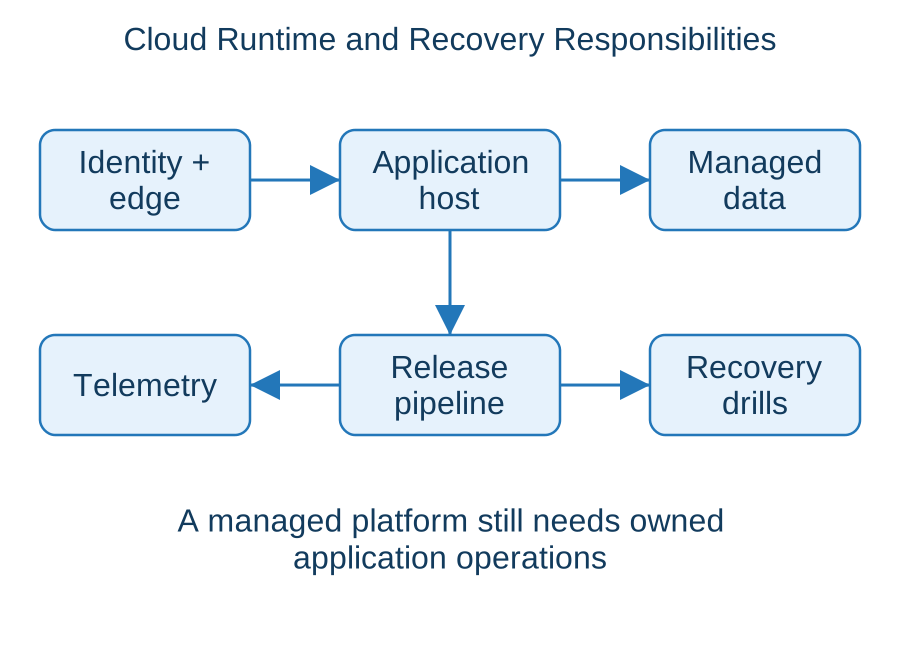
Select an Operating Model That Fits the Workload
We map each application component to its execution and state requirements. An ASP.NET Core API receives its managed host, scaling and ingress configuration; a durable worker receives the queue, concurrency and restart behaviour needed for its work. Azure SQL or PostgreSQL/RDS stores transactional records, with Blob Storage or S3 for identified objects. Managed identities or IAM roles, private connectivity and secret access are configured for the selected resource path.
Build Application Lifetime and State Deliberately
C# services use the .NET hosting model for dependency injection, configuration and managed startup and shutdown. We design request processing and background jobs with explicit cancellation, concurrency and persistence boundaries. Work that must survive an instance replacement is recorded durably rather than retained only in memory. Database migrations are versioned with the release, and external operations receive clear retry and reconciliation rules. Where Sphere10 Framework is selected, its application and data-access foundations support the implementation inside the host.
Make Releases Repeatable and Health Observable
Bicep or Terraform records the selected environment, while the application pipeline produces a versioned .NET package or container image and compatible database migration. Managed-host health signals and OpenTelemetry data distinguish failed requests, saturated workers and unavailable dependencies. Azure Monitor or CloudWatch alerts point to an owned response. We exercise configuration rollout, instance replacement, denied access and restoration of the records needed by a representative business operation.
Exercise Recovery Before Operational Handover
Acceptance includes a realistic deployment, an unavailable dependency, an interrupted worker and restoration from the chosen backup mechanism. We measure recovery against the agreed scope and retain the configuration and data assumptions behind that evidence. The handover provides source, infrastructure definitions, dashboards, access responsibilities and support procedures. Our Local Notion work is a concrete reference for a .NET pipeline with retained local data and generated publications; cloud projects receive their own tested storage and deployment design.
Technologies & Integration
Discuss Your Project Back to Services
Microservices Architectures
Sphere 10 builds microservices with ASP.NET Core REST or gRPC APIs and durable messaging through RabbitMQ, Kafka or Azure Service Bus. Each service owns a business capability, its write model and its release contract, using SQL Server, PostgreSQL or another selected store for that boundary. Docker and Kubernetes deployment, optional Dapr building blocks and OpenTelemetry are integrated around the actual consistency, scaling and support requirements of the workflow.
Our implementation covers APIs, asynchronous messaging, persistence, release automation and observability as parts of the same system. C# and ASP.NET Core provide service hosts and business interfaces, while each service retains explicit local transaction boundaries. Cross-service completion is handled through designed workflows, durable state and reconciliation. You receive deployable services and the evidence needed to change them independently, alongside contract documentation, recovery procedures and operational signals that let your team understand the complete business journey.
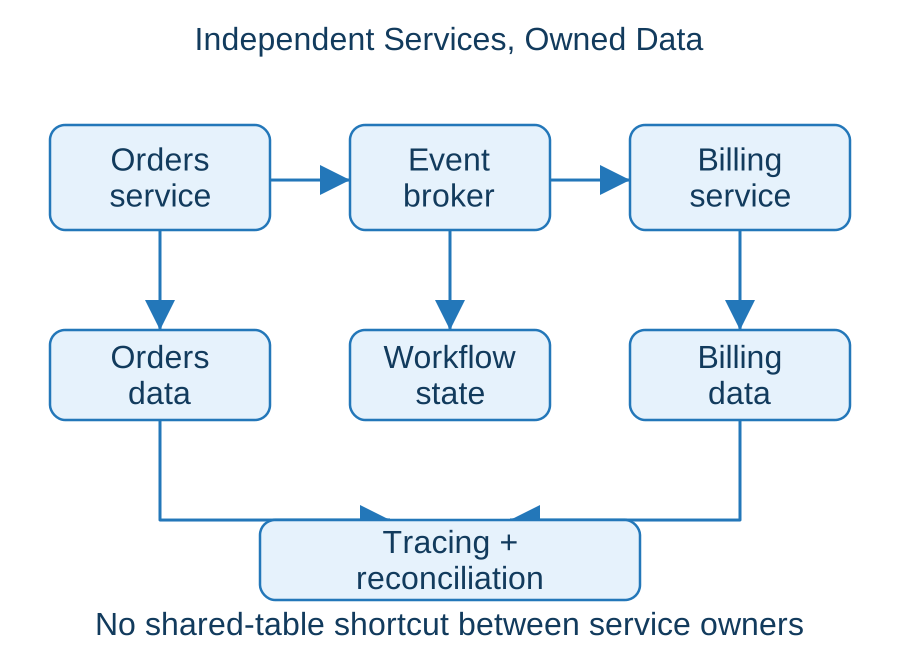
Find Boundaries With Independent Business Meaning
A service boundary starts with records and invariants that can be owned together. The C# application service commits its own SQL Server or PostgreSQL changes and exposes a versioned HTTP/gRPC operation or business event. Database credentials and deployment permissions reflect that ownership; consumers receive contracts or projections for their work. We test a vertical slice through its API, messages and data migration before separating the next capability from an existing application.
Design Contracts and Distributed Completion Explicitly
An HTTP response, an event publication and a completed business workflow represent different boundaries. We define request identity, timeout behaviour, error contracts and compatibility rules for synchronous calls. Asynchronous work uses durable messages, idempotent processing and appropriate outbox or inbox mechanisms. Where multiple owners must complete an operation, we implement a visible workflow with recorded progress and compensation or reconciliation rules. Each service manages its own local database transaction; the cross-service policy remains application code with explicit tests.
Operate Independent Releases as One Observable System
Kubernetes Deployments, Services, resource limits, probes and rollout settings are delivered with the container image and compatible configuration. Helm values or the selected infrastructure definitions record each environment. Dapr pub/sub components, where selected, have explicit broker, retry and message-handling ownership. OpenTelemetry connects the services and messages to a business correlation, while contract tests and release checks prove coexistence with the current consumers.
Prove Independent Change and Partial Failure
Acceptance includes releasing one service while its consumers remain on the previous compatible contract. We stop a dependency, delay a message, repeat a request and restart a participant during an active workflow. Tests verify that progress remains explainable and that recovery does not duplicate business effects. Delivery includes source, contracts, deployment configuration, integration fixtures and operational dashboards. Your team receives a service map and recovery runbooks that connect local responsibilities to the complete system’s behaviour.
Technologies & Integration
Discuss Your Project Back to Services
MERN Architectures
Sphere 10 builds MERN applications that connect a clear React user experience to well-defined Express APIs, Node.js processing and a MongoDB model shaped around actual work. We deliver customer portals, operational dashboards, marketplaces and workflow applications with attention to the full path from a user action to a durable business result. The architecture makes validation, identity, data access and background processing explicit from the first working slice.
We use the native strengths of the stack while giving integrations and operating responsibilities a precise contract. TypeScript helps express application interfaces; runtime validation checks the data that actually arrives. MongoDB modelling follows access patterns and consistency needs, and Node workloads are designed around their concurrency and resource profile. Where your business also uses .NET services, we build an intentional API or messaging boundary. You receive a coherent MERN system with tested workflows, repeatable releases and practical support and recovery documentation.
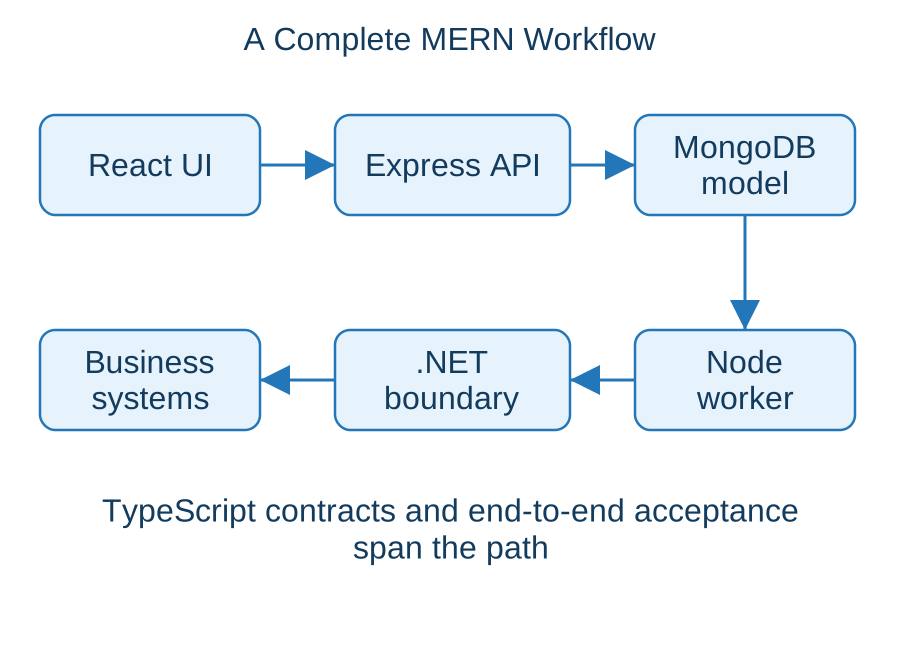
Shape React State Around the User’s Task
React and TypeScript components separate editable form state from server-owned query results. We define route parameters, request cancellation and cache invalidation around the operation, using a selected query/state library where it fits. Forms handle validation, submission and version conflicts explicitly, with runtime-validated API responses and usable loading or failed states. Keyboard navigation, responsive content and the result of returning from authentication are tested through the same workflow.
Model MongoDB Around Access and Consistency
MongoDB document boundaries follow the operations that must update together. We select embedding or references, unique and compound indexes, stable pagination and schema validation against realistic queries and document growth. Single-document atomic updates or a deliberately scoped multi-document transaction enforce the chosen invariant. Express middleware supplies authentication, authorization, request validation and error handling; TypeScript types are paired with runtime checks at the incoming JSON boundary.
Integrate Background Work and Existing Business Systems
Node.js request handlers remain bounded and asynchronous; CPU-heavy work uses a selected worker-thread or separate-worker design, with durable jobs for work that must survive a process restart. The application records the external-operation identifier and result before retrying a payment, notification or import. ASP.NET Core domain services are integrated through versioned OpenAPI or message contracts, and the MongoDB/Node and SQL/.NET sides retain explicit ownership of their records.
Deliver and Accept the Complete MERN Application
We exercise the workflow from the browser through the API and database, including unauthorised requests, invalid data, dependency failure and restarted jobs. Performance testing uses realistic document sizes and concurrent users. The release package includes source, environment configuration, database indexes or migration procedures, build instructions and operational monitoring. Handover explains how to deploy, rotate configuration, restore data and investigate a failed user action. The resulting application is ready to be maintained as a complete product across its browser, server and data components.
Technologies & Integration
Discuss Your Project Back to Services
Data Lakes & Warehouses
Sphere 10 engineers analytical platforms with Microsoft Fabric/OneLake, Azure Data Factory, Databricks/Delta Lake, Snowflake or AWS Athena according to the data and operating model. We connect SQL Server, PostgreSQL, business APIs and files through owned ingestion and transformation pipelines, with Parquet or Delta storage where appropriate. The delivered lake or warehouse includes source lineage, validated data, business-grain models and Power BI or other reporting whose figures can be reconciled.
Our delivery combines C# ingestion services with the storage and query platform suited to the workload. We define source identities, checkpoints, schema changes and reconciliation before building dashboards. Analytical tables then express the grain, dimensions and measures your team actually needs. BlockchainSQL provides a concrete Bitcoin-focused reference for transforming specialised source records into SQL-facing data. We apply that discipline to your pipeline, delivering reproducible transformations, quality checks and operating procedures that keep the analytical model aligned with its sources.
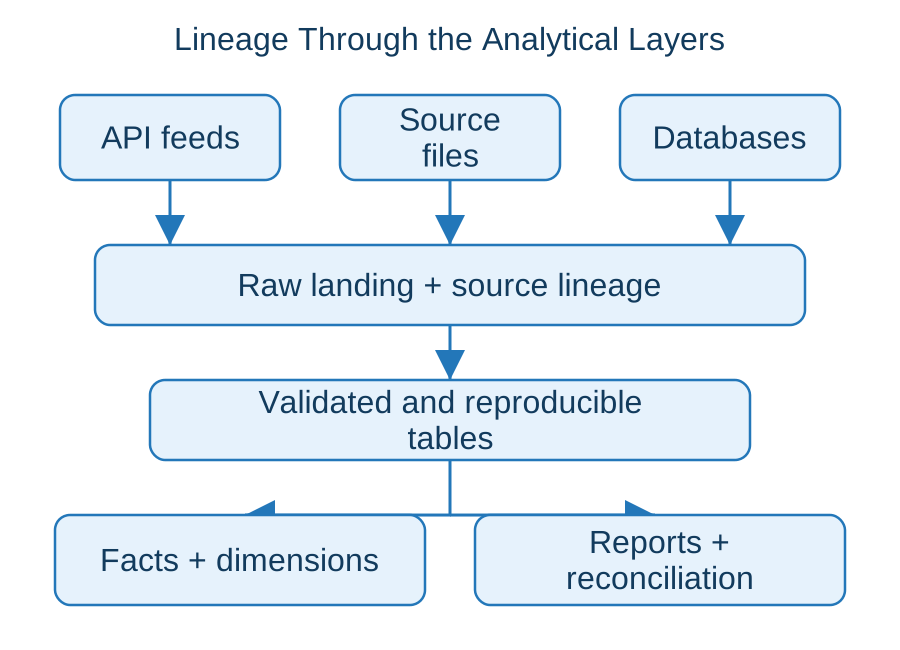
Retain Source Evidence and Establish Ownership
We identify the authoritative source for each dataset and the extraction contract it exposes. Raw landing records retain useful source identifiers, extraction time and schema context so transformations can be rerun and investigated. We distinguish a complete snapshot from an incremental change feed and define how deletions or late arrivals are represented. Access and retention policies follow the sensitivity and purpose of the data. The resulting source catalogue explains what was received, when it was received and who owns its meaning.
Engineer Repeatable Ingestion and Quality Controls
Azure Data Factory or the selected orchestration platform coordinates connector extraction and repeatable batches; C# workers handle the specialised APIs and business transformations that need application code. Each batch records its source watermark, schema generation, accepted/rejected records and completion. Databricks/Spark or the chosen warehouse engine writes the selected Parquet or Delta tables, with business-key merge and rerun rules. Schema changes and late or deleted records are tested against the published model.
Build an Analytical Model With Agreed Business Meaning
We design the warehouse or lakehouse around fact grain, dimensions, effective dates and agreed measures. Fabric, Snowflake or the selected query platform receives the partitions, access roles and transformation ownership appropriate to its workloads. Power BI relationships and DAX measures are reviewed with business examples, including row-level access where required. Reconciliation checks totals and record counts back to the retained source generation before the dataset is accepted.
Prove the Numbers and Hand Over the Pipeline
Acceptance reconstructs selected results from their source range and compares counts, totals and business examples with agreed expectations. We interrupt ingestion, rerun a partition and apply a schema change to verify the recovery design. The delivery package includes pipeline source, orchestration configuration, dataset definitions, quality rules and operational dashboards. Your team receives procedures for investigating a failed batch, correcting rejected records and rebuilding a derived dataset. The platform is supported by an explainable chain from source evidence to business decision.
Technologies & Integration
Discuss Your Project Back to Services
On-Premise Solutions
Sphere 10 delivers installed .NET applications on Windows Server/IIS or Windows Services, and Ubuntu/RHEL-family Linux with systemd. SQL Server, PostgreSQL or SQLite is selected for the local transaction, concurrency and recovery requirement. We integrate the site's Active Directory or chosen identity provider, storage, network and operational procedures, including environments with controlled internet access. The system is packaged, commissioned and handed over with owned configuration, durable data and a tested update/restore path.
Our delivery includes the application and the installation your team must maintain: versioned packages, configuration, service registration, durable data, diagnostics and tested recovery. C# services can provide local APIs, scheduled processing and operator interfaces with clear responsibility for credentials and stored records. Local Notion offers an inspectable reference for retaining Notion content on local storage and producing offline HTML or publications. We bring that attention to owned data and repeatable operation to the specific requirements of your installed business system.
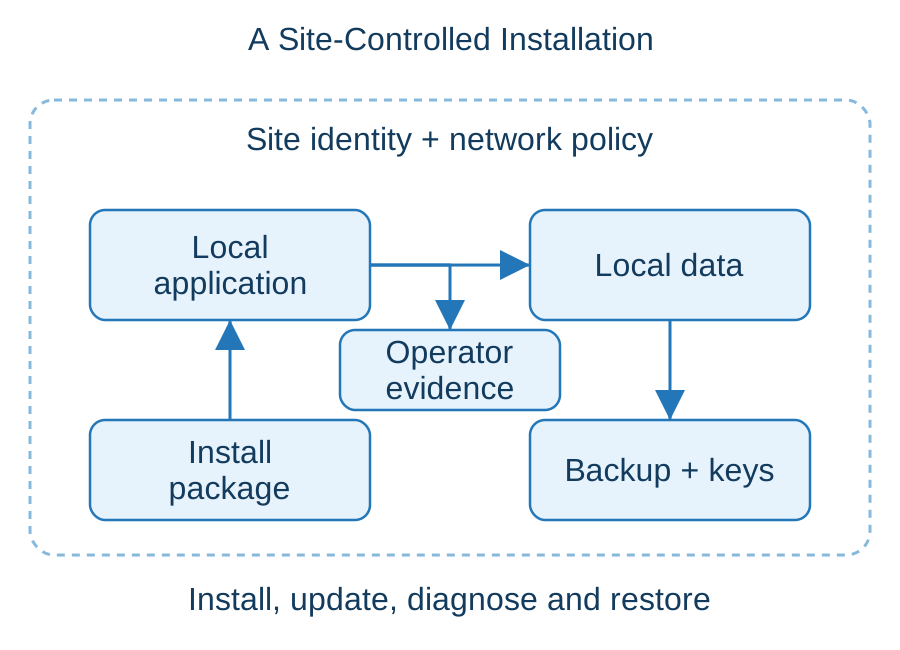
Map the Site’s Dependencies and Responsibilities
We map Windows/Active Directory identities, local service accounts or the selected installed OpenID Connect provider to the application's actual permissions. Database authentication, SMB or local file access, certificates and administrative entry points receive explicit owners. The dependency record distinguishes local DNS/identity/storage from required external feeds or services. An isolated-site acceptance test exercises the functions expected to remain available and the queued work that resumes when the dependency returns.
Package Application Lifetime and Durable State Together
Windows delivery registers the selected IIS application or .NET Windows Service with the matching runtime, account and NTFS permissions; Linux delivery includes the systemd unit, service user and working directory. SQL Server or PostgreSQL data and uploaded files live outside replaceable application packages. Embedded SQLite receives a deliberately scoped connection/concurrency and backup policy. Versioned migrations and retained release packages establish the update and recovery decision points.
Make Maintenance and Access Practical for Operators
PowerShell or the selected configuration automation records installed versions, service settings, permissions and operating checks. Operators can inspect Event Viewer or journalctl evidence, validate the active configuration and collect application diagnostics through the agreed access model. Restricted sites receive the required installation prerequisites and an explicit package-transfer procedure. Maintenance separates OS/runtime changes, application releases and data migrations so the support team can verify and recover each generation.
Accept Installation, Upgrade and Restoration
We test the deployment on the intended class of host and exercise the operational journeys alongside the business features. Acceptance includes restarting the service, recovering interrupted work and restoring data into a clean installation. Backup testing covers the configuration and keys required to make restored records usable. Delivery includes source or agreed distribution artefacts, installer instructions, migration scripts and runbooks. Your team receives a system it can install, update and recover using documented steps and retained evidence from the actual acceptance exercises.
Technologies & Integration
Discuss Your Project Back to Services