Consulting Services
Business Consulting
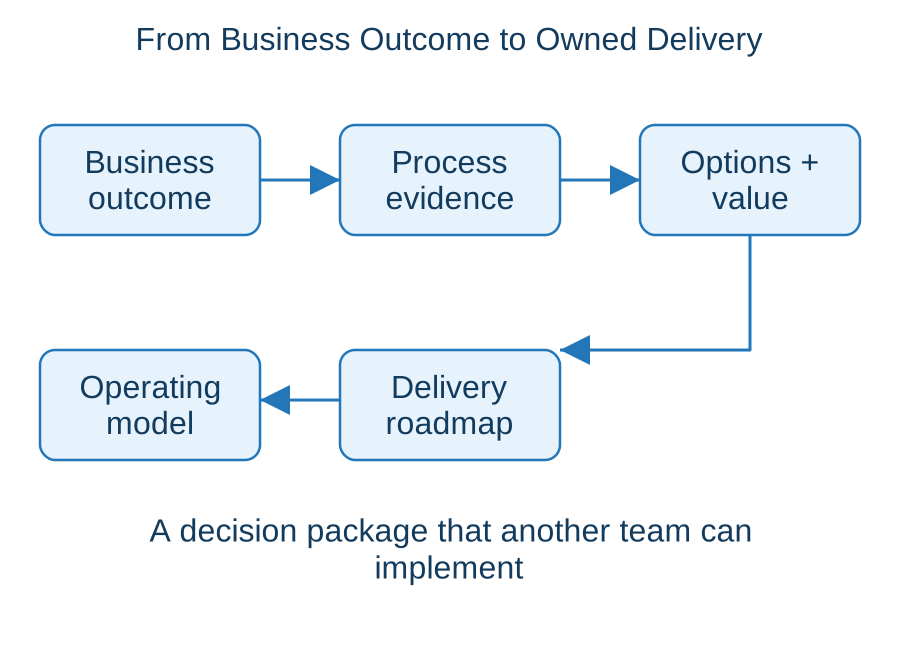
Sphere 10 turns business processes into an implementable platform, integration and delivery plan. We assess workflows across Microsoft 365, Notion, Dynamics 365 Business Central, Xero and existing line-of-business systems, then identify where configuration, Power Automate, reporting or a focused .NET application best serves the requirement. Decisions cover record ownership, API boundaries, operating responsibility, measurable outcomes and the commercial phases needed to commission the work.
Our consulting connects business design to implementation. We map workflows, ownership, data and integrations, then develop a prioritised package that a delivery team can act on. Our software engineering background keeps operational and technical consequences visible while options are still being considered. You receive decisions with reasons, acceptance criteria and an operating model alongside the roadmap. The work can progress into a defined Sphere 10 build, or close with a usable plan and handover for your chosen implementation team.
Understand the Work Before Selecting the Tool
We map a representative process using explicit actors, records, decisions and exception paths, with BPMN where a formal workflow model is useful. An order-to-invoice journey identifies which system owns the customer, price, stock movement and accounting record. Existing Notion or Microsoft 365 forms, spreadsheets and approvals are inspected against that flow. The output names the decision rules and information required at each hand-off, together with the evidence used to measure improvement.
Compare Options With Their Operating Consequences
Options are compared using the same workflow: configure the current ERP/CRM, connect APIs with Power Automate, build a Power BI model, or implement the required .NET service and interface. Business Central or Xero integration is assessed through its actual entities, authorization and update contract. We include licence/operating requirements, data migration, failure handling and support ownership in the comparison. Framework and Local Notion experience informs the application and content-ownership decisions.
Create a Roadmap With Testable Business Outcomes
Project Design produces the process model, field and integration definitions, prototype evidence and a delivery scope with observable acceptance. Project Delivery is organised around a complete business slice and its data migration, operator workflow and handover. Project Execution defines who owns the installed result, monitoring and subsequent changes. The roadmap states dependencies, integration proofs and training needs so each commissioned phase has a concrete output and acceptance decision.
Agree the Commercial Phases and Handover
Project Design begins with paid time-and-materials discovery and requirements work. Once the implementation is sufficiently defined, Project Delivery can proceed as fixed-price RAD work with an initial deposit, one client review-and-change round and an acceptance payment. QA is agreed separately as time and materials or fixed price according to its extent. Project Execution establishes the ongoing SLA for the activities and systems we operate. The consulting handover retains the reviewed decisions and working material so the organisation can act on the advice.
Technologies & Integration
Discuss Your Project Design Back to Consulting Services
Notion Consulting
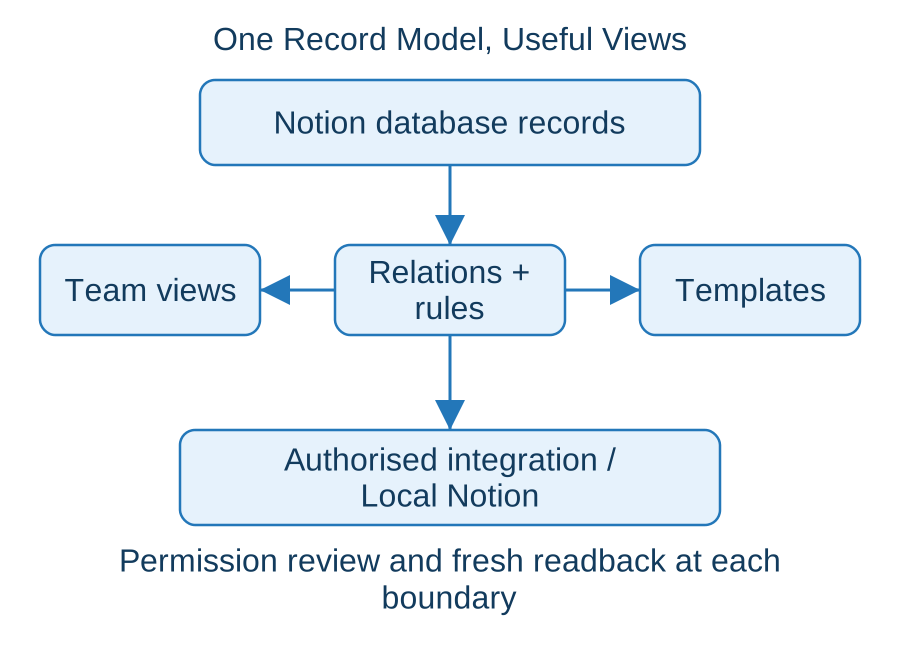
Sphere 10 designs Notion databases, data sources, relations, rollups, formulas, templates and purpose-built views around the work your team performs. We create coherent project, customer, delivery and content models, then connect business systems through the Notion API and controlled automation. Our Local Notion .NET platform supplies a concrete publishing and local-retention implementation, with Page/block identity, media, source refresh and website output checked at their actual boundaries.
Our service combines workspace design with software engineering. We model the databases and user journeys first, then connect external applications or publication workflows through explicit integration boundaries. Our Local Notion platform provides a concrete reference for retaining Notion data on your own storage and generating HTML, offline publications and websites. You receive an organised workspace, repeatable operating conventions and tested integrations, with a handover that explains how records, permissions and synchronisation are maintained as the team and its processes evolve.
Build a Coherent Record and Relationship Model
We distinguish the Notion database container, its data-source schema and the Pages holding records. Customers, projects, deliverables and decisions receive stable identities, typed properties and explicit relations. Status values describe a real transition and owner; formulas and rollups expose useful derived context. Templates establish consistent capture while linked views present the same underlying records for delivery, review or publication. The model is tested with actual exceptions and completed work.
Create Views and Permissions for Real Responsibilities
A view serves a task: capturing a request, planning delivery, reviewing a decision or preparing content for publication. We configure filtering, grouping and properties around those responsibilities while retaining one coherent record model. Permissions are reviewed with the people and connections that need access. In a Local Notion CMS, for example, a Services overview editing view can show its Sections without being cluttered by every nested offering Page. The underlying records and their identities remain consistent across those purpose-specific views.
Integrate Notion Through Explicit Ownership Boundaries
An integration owns named properties and a recorded operation identity. The client follows Notion pagination, request limits and Retry-After behaviour, and handles relation or rollup data that requires separate reads. Webhooks trigger a fresh source read and an idempotent processing outcome. For Local Notion, the integration verifies native Page/block state, original attachments, cached source, rendered themes and served routes independently, including changes inside nested Columns whose owner header did not change.
Accept the Workspace as a Working Business Process
Acceptance follows complete tasks with representative users and records. We test creation, reassignment, review, completion and the exception paths the team encounters. Integration checks confirm the actual saved properties, relationships and publication output, including permission-denied or unavailable-source cases. The handover includes the database model, templates, role conventions, integration configuration and maintenance notes. Your team receives a workspace it can operate deliberately, with clear procedures for adding a new record type, changing a status or investigating information that has not reached its expected destination.
Technologies & Integration
Discuss Your Project Design Back to Consulting Services
Web3 Consulting
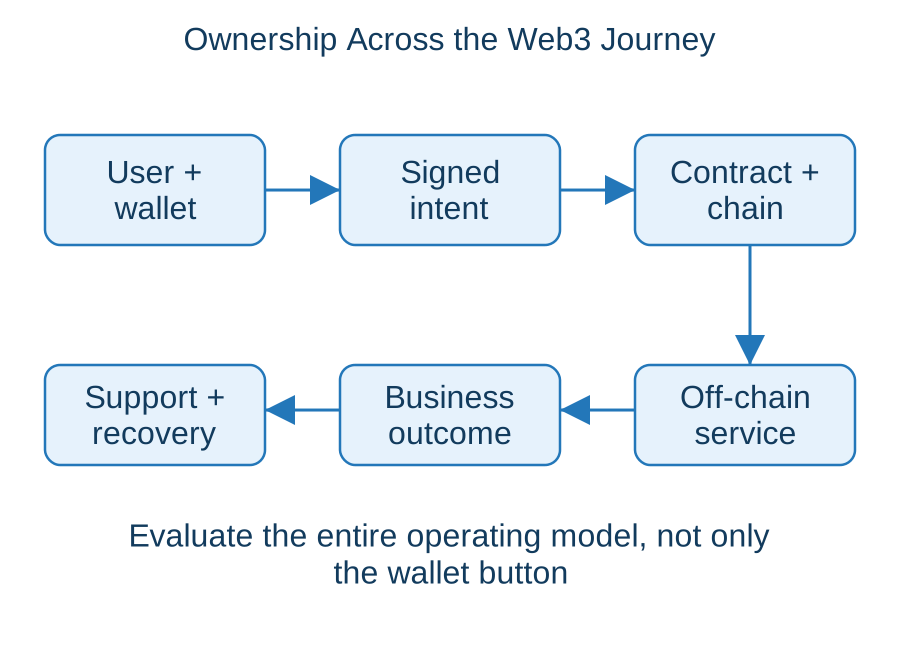
Sphere 10 designs Ethereum/EVM and Bitcoin integrations as complete products: wallet interaction, contract or node operation, C# services and the resulting business workflow. We specify signing authority, transaction state, event projections and recovery, using Solidity/OpenZeppelin and Nethereum for selected EVM work and Bitcoin-specific node interfaces where required. The engagement produces a technical prototype and delivery plan connecting user consent to an owned, traceable application outcome.
We bring protocol, cryptographic and .NET application engineering into the product discussion early. That makes custody, signing authority, confirmation, data ownership and operational support visible before interface and platform choices become expensive commitments. We develop architecture, prototypes and an implementation roadmap grounded in the intended user journey. You receive a practical plan for the on-chain and off-chain components together, including the controls and acceptance evidence required to operate the product after its initial release.
Make Custody, Identity and Rights Explicit
Ethereum wallet integration follows the EIP-1193 provider boundary, including account and network changes. Sign-In with Ethereum uses ERC-4361 message fields and an application-checked domain, nonce and expiry; EIP-712 provides typed signing for the selected structured intent. We define chain ID, signer authority, replay handling and credential recovery with the product's identity model. A wallet signature and the business permission it authorises are connected by an explicit application rule.
Design the Transaction Journey and Off-Chain Work
The transaction journey records preparation, signature rejection, submission, receipt, confirmation and business completion. Nethereum/C# services use the agreed ABI, JSON-RPC methods and chain identifiers, retaining transaction, block and log identity for replayable projections. Replacement transactions and reorganised observations have reconciliation rules. Bitcoin integrations define their UTXO, wallet/descriptor, PSBT and confirmation responsibilities separately. The prototype proves the selected signing-to-fulfilment path and a delayed or interrupted outcome.
Review Governance and Dependencies as Product Design
We identify who can change contracts, pause functionality, supply external facts or alter the application’s rules. The assessment considers node providers, wallets, indexing services and any bridge or external-contract dependency the product intends to use. Technical choices are evaluated with their user and operating consequences, including fees, upgrade approval and data visibility. Commercial or legal review receives a defined set of product facts and decision points. A focused prototype proves the most important interaction or trust assumption before the full implementation is commissioned.
Deliver a Product and Operating Roadmap
The engagement produces the user-journey model, component architecture, responsibility matrix and a phased delivery scope. Acceptance criteria cover both contract behaviour and the complete application experience, including support and recovery. We define the records, dashboards and runbooks needed to explain an individual transaction after release. The work can progress into implementation of the selected contract, service and interface components. Your team receives the source material, prototype evidence and operational decisions needed to maintain a coherent product across its wallet, network and business boundaries.
Technologies & Integration
Discuss Your Project Design Back to Consulting Services
IT Consulting
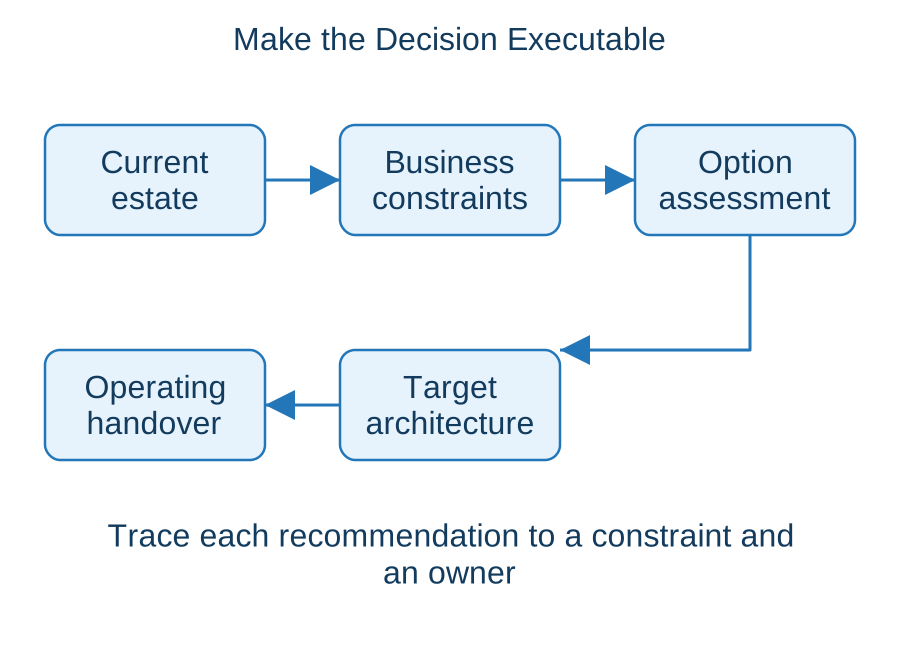
Sphere 10 provides IT consulting across Microsoft365, Entra ID, Intune, Windows/Active Directory, Linux, virtual infrastructure, Azure/AWS and .NET business applications. We connect identity, endpoint management, networks, SQL data, backup and application lifecycle into an implementable operating plan. The assessment identifies the actual product configuration and dependency behind each recommendation, with a phased migration, acceptance evidence and an accountable owner for the resulting environment.
Our advice is informed by building and operating software. We examine how a proposed platform will be deployed, maintained, monitored and recovered, and who will own those responsibilities. That includes C# and .NET applications, Windows or Linux hosts, cloud services and existing business systems. You receive a reasoned target architecture and a phased roadmap with defined outcomes, acceptance evidence and ownership. The resulting package supports procurement, internal planning or a Sphere 10 implementation without leaving critical decisions hidden in informal conversations.
Understand the Estate and Its Real Dependencies
The estate review maps Microsoft365/Entra tenants, Active Directory, managed endpoints, Hyper-V/vSphere or Proxmox hosts, business applications and their SQL/data stores. We inspect service identities, admin access, patch/runtime support, backup and representative network paths. The applicable CIS Controls and product Benchmarks provide a structured baseline, with NIST CSF outcomes framing priorities and evidence. Findings retain the actual system, configuration, operational consequence and closure test.
Compare Options Against a Common Set of Requirements
We compare a supported .NET upgrade, product replacement, API integration or infrastructure move against compatibility, data migration and the support model. Entra Conditional Access and Intune management are evaluated with the organisation's identity, device and licensing requirements. Azure/AWS managed hosting or retained on-premise infrastructure receives the same workload and recovery criteria. Where an ISO/IEC27001 programme is in scope, technical asset, access and recovery evidence is mapped to the agreed ISMS responsibilities.
Build a Transition Plan With Observable Outcomes
The roadmap starts with a bounded identity, migration or integration proof, then defines staged configuration, cutover and recovery decisions. An Entra policy change includes the selected test/report-only approach and retained emergency administration; an application change includes a representative transaction and supported runtime inventory. Operators receive the backup/restore, monitoring and escalation requirements for each phase. Acceptance records the useful user and support functions demonstrated on the resulting platform.
Hand Over Decisions That Can Drive Delivery
The consulting package includes the current-state assessment, target architecture, decision record and prioritised implementation scope. Requirements and acceptance examples are detailed enough to support internal delivery or procurement. We review the plan with the people who will own the systems, then identify outstanding decisions and their responsible parties. The engagement can proceed through paid Project Design into defined delivery and separately scoped QA, with ongoing operational responsibilities agreed through Project Execution. Your organisation retains an actionable technical baseline and the material needed to commission, accept and operate the resulting change.
Diagram source
flowchart TD
  E["Code, data and infrastructure"] --> A["Measured technical assessment"]
  A --> O["Platform and architecture options"]
  O --> P["Prototype the critical assumption"]
  P --> D["Architecture decision record"]
  D --> B["Delivery backlog + acceptance criteria"]
classDef default fill:#eaf2ff,stroke:#2f77cb,color:#17365d,stroke-width:1.5pxTechnologies & Integration
Discuss Your Project Design Back to Consulting Services