Blockchain Services
NFT Development
Sphere 10 develops NFT applications around the asset and the business process it represents. We build membership platforms, digital certificate registers, collectable products and transferable entitlements, including the contract, customer interface, .NET backend and administration tools. The design connects on-chain ownership with the information and operational actions your product needs, from issuance and transfer to support and reconciliation.
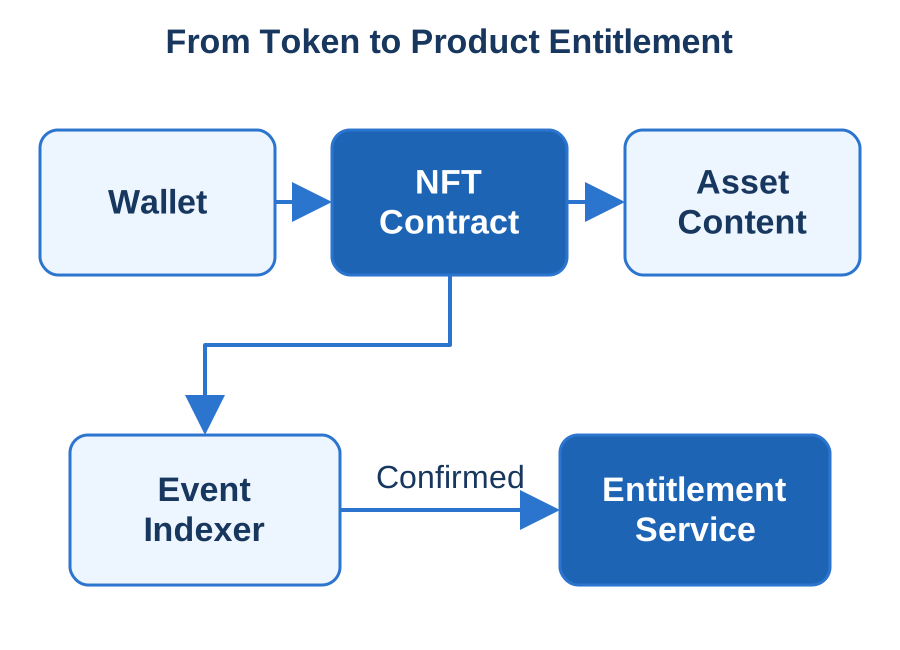
The useful starting point is a clear asset lifecycle. Who can issue an item, what does a holder receive, how can it move and what happens when information changes? We translate those answers into contract rules, metadata, access checks and understandable user journeys. ERC-721 or ERC-1155 can supply standard interfaces on EVM networks, while application services manage the surrounding business records. We engineer the complete system, including wallet interactions, event processing, content retention and the tools your team uses after launch.
Specify the Asset and Its Lifecycle
We define issuance, ownership, transfer, expiry or revocation behaviour around the actual product. A certificate, a membership and a collectable edition have different requirements. The specification identifies which rules are enforced by the contract and which belong to the application's service or administration layer.
On Ethereum and compatible EVM networks, ERC-721 models individually identified assets and ERC-1155 supports multiple asset types in one contract. We implement mint/burn authority, transfers, approvals and metadata updates using selected OpenZeppelin components. ERC-2981 supplies royalty information; payment behaviour still depends on the receiving marketplace. For Solana work, we assess Metaplex Core for new assets and Token Metadata compatibility for existing collections against the required wallets and marketplaces.
Build the Product Around the Contract
Nethereum connects C# services to EVM contract calls and events. ASP.NET Core exposes the application operations used by the customer interface and administration tools. Sphere10 Framework supplies reusable application and data infrastructure, while your product owns its asset rules, eligibility and customer records.
The surrounding application tracks contract addresses, token identifiers, ownership events and content references separately from customer records. BlockchainSQL Server demonstrates Bitcoin ingestion into a relational database and explorer; the same checkpoint/rebuild discipline informs an NFT indexer's design. EVM adapters use Nethereum, while a Solana asset uses its own program/account interfaces. IPFS content identifiers require a pinning and retention plan so referenced metadata and media remain available.
Test Ownership, Events and Adverse Paths
Acceptance follows the complete asset journey on the agreed test network: issue, inspect, transfer and use the entitlement. We test rejected signatures, insufficient funds, unavailable providers and interrupted submissions. The interface explains what remains pending and which actions the user can safely take next.
Contract tests cover unauthorised minting, receiver behaviour, approval changes, supply limits and any pause, rental or entitlement rules the product implements. Indexing tests replay duplicate events, restart from checkpoints and reconcile chain changes before updating derived ownership views. We exercise metadata changes and unavailable gateways alongside the customer journey. Independent contract review can be a release milestone against the specified source and deployment configuration.
Deliver Source and Operational Ownership
We provide contract source, deployment configuration, ABI artifacts and the application code with a record of deployed addresses. The handover identifies keys, administrative permissions, metadata hosting and the services needed to operate the product. Your team can reproduce the build and trace a customer issue through its transaction and application records.
The release record identifies network, deployed program or contract, ABI/schema, administrative authority and metadata update policy. Operators receive minting/reconciliation tools, monitoring and documented content retention. Acceptance follows issue, inspect, transfer and use of the asset through the real application, with the selected wallet and marketplace integrations. Source and deployment procedures make subsequent collection changes traceable to the accepted contract and application baseline.
Technologies & Integration
Discuss Your Project Back to Services
Full-Stack MVP Development
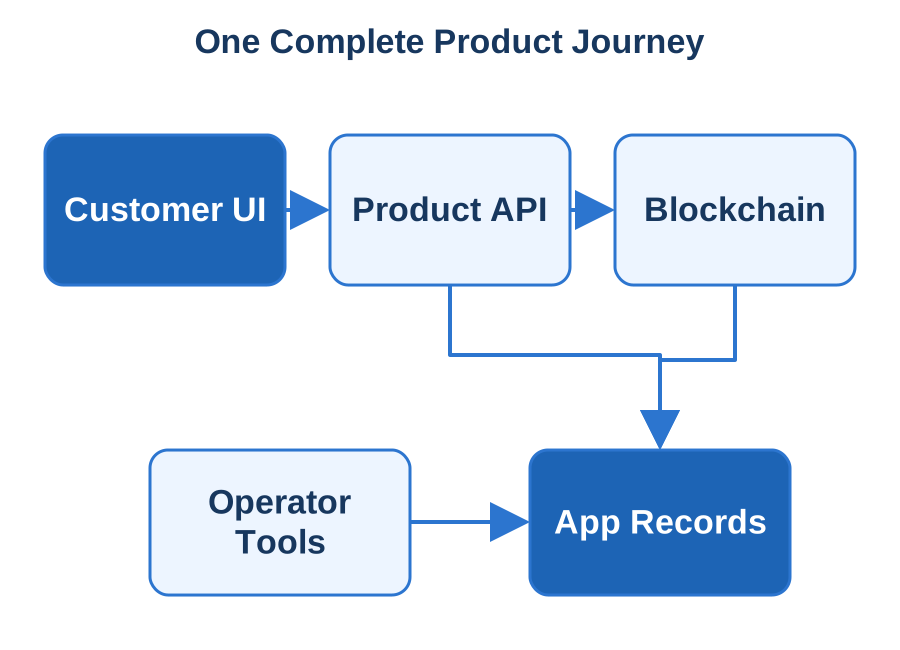
Sphere 10 takes blockchain product ideas through to a working first release. We deliver the customer interface, application services, contract or node integration, data storage and deployment as one coherent product. The MVP is shaped around a business journey people can complete: issue a credential, transfer an asset, reconcile a payment or inspect independently verifiable records. That journey gives the build a useful commercial and technical boundary.
Our usual application foundation is C# and ASP.NET Core, with Blazor or an appropriate web interface and the chain-specific components the product requires. We define the authoritative state, transaction lifecycle and operator actions before expanding features. Our BlockchainSQL Server work provides a concrete reference for ingestion, processing, relational storage and explorer presentation. We bring that end-to-end engineering approach to your first release, retaining a clear path from customer action through the chain to a supportable application result.
Turn the Proposition Into a Buildable Journey
We identify the user, the transaction or record the product exists to enable and the evidence of success. The initial scope includes the steps needed to complete and support that journey. Account creation, wallet connection, permissions and administration are considered alongside the visible product feature.
Project Design selects a working vertical slice and its dominant stack: ASP.NET Core/C# business APIs, a Blazor or React/TypeScript web interface, or MAUI when an installed mobile client is required. SQL Server or PostgreSQL holds the authoritative application records. We define the first useful journey, integration dependencies and measurable acceptance examples before expanding the backlog, so the MVP can validate the proposition through a complete working product.
Implement Every Layer of the Working Product
ASP.NET Core services own business operations, access checks and integration. A Blazor or selected web interface presents the customer journey, while adapters isolate payments, messaging, external APIs or a blockchain node when those capabilities belong in the product. The application data model supports query and administration and records the difference between an accepted request and its completed external outcome.
Sphere10 Framework contributes compatible application composition, persistence, serialisation and logging infrastructure. OpenID Connect authentication and server-side authorisation protect the chosen workflow; billing, messaging and other providers receive explicit adapters where required. BlockchainSQL Server is a reference for ingestion and a usable data interface when chain-backed data belongs in the proposition. Each selected component has a clear contract and operating owner.
Prove Behaviour Across the Complete Journey
Acceptance uses representative records and the accounts required by the agreed environment. We test rejected actions, lost responses, delayed external outcomes and service restarts with work outstanding. A customer can tell whether an action was requested, is still processing, completed or was rejected, while support staff can locate its operational history.
We test the boundaries that make the proposition work: identity, permissions, persistence and the critical external integration. Playwright can exercise the web journey while .NET tests verify application rules and failure recovery. Duplicate callbacks, provider outages and restarted workers receive recorded outcomes and reconciliation rules. Workload checks use the first release's expected records and concurrency, giving the next delivery phase an observed operating baseline.
Hand Over an Accepted Product and the Next Decisions
Delivery includes application source, build instructions, deployment assets and a clear account of account, key and data ownership. Operators receive the diagnostic and recovery procedures needed for the released workflow. We record the tested environment and dependencies so your team can reproduce the product and investigate issues.
The agreed Project Design defines delivery scope, acceptance and the next prioritised decisions. Handover includes application source, schema migrations, configuration and deployment instructions; contract source and chain addresses are included when the product uses them. Operators receive diagnostics and recovery procedures for the released workflow. The follow-on backlog is grounded in the accepted build and observed user needs, with additional QA or continuing execution scoped explicitly.
Technologies & Integration
Discuss Your Project Back to Services
POC Development
Sphere 10 builds proofs of concept that answer the technical question holding up a project decision. We investigate blockchain protocols, contract behaviour, node integration, data ingestion, cryptographic formats and performance-sensitive processing using focused executable experiments. The output is evidence you can inspect, reproduce and use to decide the next engineering step, with the test conditions and remaining uncertainties made explicit.
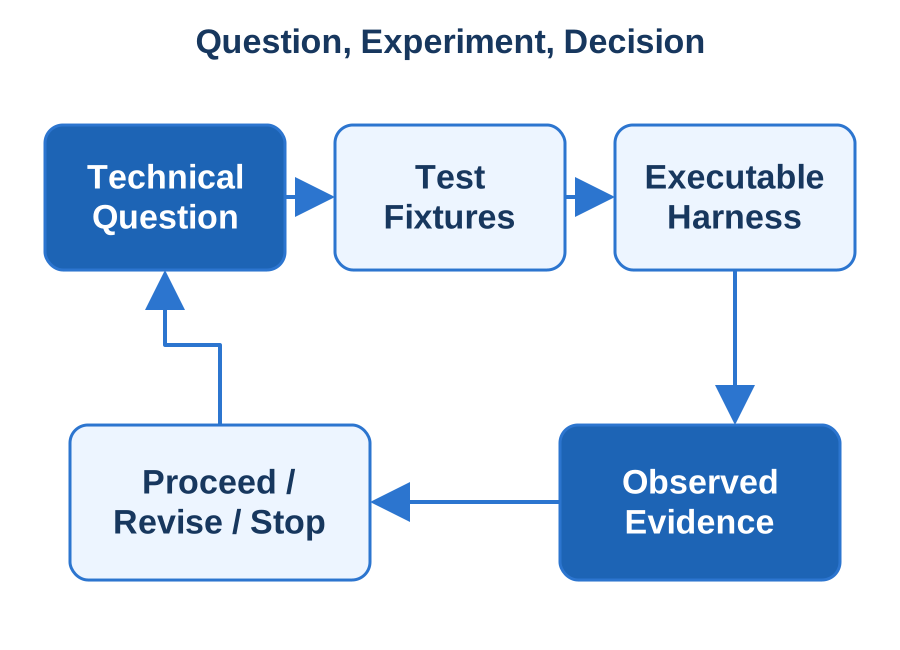
A useful POC starts with a specific decision: can a node provide the required history, can an indexer recover after a fork, or can a processing path sustain the intended workload? We define the hypothesis, representative inputs and acceptance threshold before building the harness. C# and our .NET infrastructure provide a productive foundation for these experiments, with native or chain-specific tools added where the question requires them. The result combines working code, measured observations and a clear recommendation for proceeding, revising the design or stopping.
Turn an Assumption Into a Test
We identify the uncertain mechanism and separate it from the rest of the proposed product. Examples include transaction interpretation, contract lifecycle rules, import throughput, signing compatibility or an external provider's data completeness. The experiment uses a small scope that can produce a meaningful answer rather than a broad demonstration.
A .NET proof of concept starts with a falsifiable question: can an API meet the required latency, can a device SDK survive the intended lifecycle, or can a chain feed recover without losing records? We define representative input, expected output and pass/fail criteria before implementation. The experiment uses the actual provider, protocol, hardware or dataset boundary that could overturn the architecture decision.
Build a Harness Around Real Boundaries
We implement the experiment against actual node APIs, protocol records and persistence mechanisms. Sphere10 Framework supplies useful binary serialisation, endian-aware reading, Merkle structures and transactional storage where relevant. These components support the harness while the experiment's evidence comes from the behaviour exercised for your requirement.
We build the smallest useful C# console harness, NUnit fixture or working UI around that boundary. Nethereum can exercise an EVM integration on the selected test environment; native interop can isolate a device or C/Rust library; an ASP.NET Core endpoint can expose an integration contract. BlockchainSQL Server's separation of input blocks, transformation and persistence illustrates how a processing POC can isolate bottlenecks and recovery behaviour.
Measure the Weak Cases as Well as the Happy Path
Correctness tests cover malformed records, duplicate inputs, incomplete history and restart during processing. Protocol experiments compare the result with an independent interpretation or known fixture where available. The test report distinguishes observed behaviour from assumptions that remain unexercised.
BenchmarkDotNet measures focused .NET code under controlled runtime and build conditions, including allocation effects where relevant. End-to-end timing separately captures network, disk and provider costs. We record dataset size, machine/runtime configuration, concurrency, cold-start versus steady-state behaviour and adverse inputs. The result explains the conditions under which the hypothesis held and the boundaries that still need a larger production experiment.
Deliver a Decision Package That Can Be Reused
Handover includes source, fixtures, results and a recommendation to proceed, revise or stop. We explain what the experiment establishes and which production responsibilities remain. Useful prototype code can be identified for retention, while temporary scaffolding and untested assumptions remain visible in the delivery plan.
Delivery contains the runnable harness, source, fixtures, dependency versions and a concise decision record. That record ties measured evidence to the recommended architecture, remaining risks and implementation acceptance criteria. Your team can rerun the experiment when a provider, library or workload changes. A successful POC becomes an informed engineering input to the production design, with operational hardening and release acceptance scoped explicitly.
Technologies & Integration
Discuss Your Project Back to Services
Enterprise Blockchain Development
Sphere 10 engineers blockchain systems for organisations that need a shared, verifiable record across operational boundaries. We design the ledger rules, application interfaces and operating model together, from enterprise applications on an existing network to purpose-built distributed ledgers. Use cases include shared asset registers, traceable business events, coordinated settlement records and verifiable exchanges between organisations with different responsibilities.
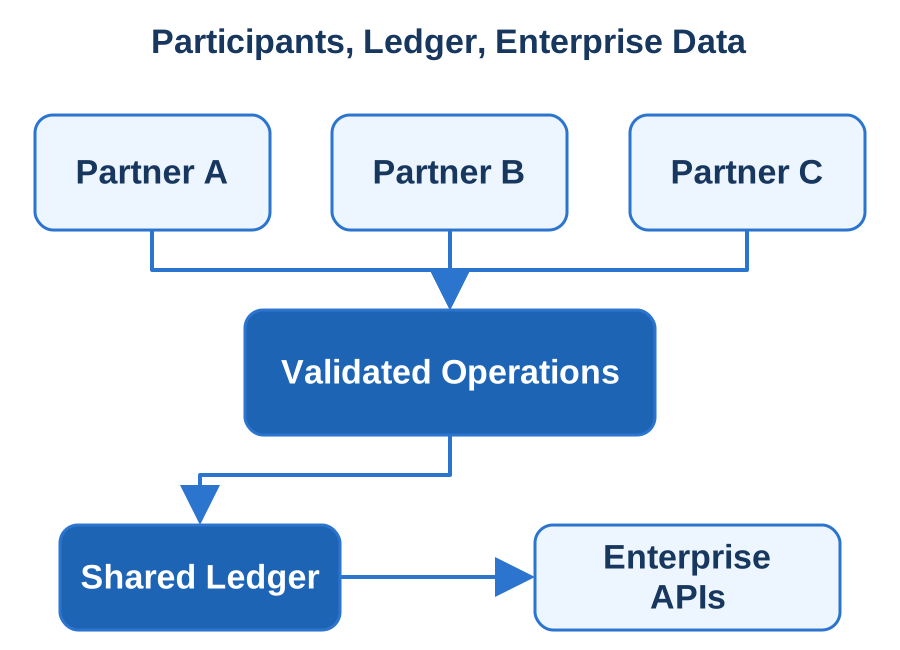
The architecture starts with who can propose a change, who validates it and what participants must be able to prove. Those answers determine identity, permissions, transaction processing and data visibility. Our .NET engineering connects the ledger to enterprise APIs, operational tools and relational reporting. Sphere10 Framework contributes reusable cryptographic, serialisation and chain-management building blocks, while the product implements the protocol and governance required by its actual participants. We deliver the whole system with explicit recovery behaviour, measurable acceptance cases and clear ownership of ongoing network operation.
Specify Participants, Authority and Finality
We define who writes records, who validates them and which participants can read the resulting information. Membership changes, privileged actions and dispute handling are explicit parts of the model. Confidential business information and shared evidence can have different storage and access requirements, so the data design separates them deliberately.
We select a ledger architecture from the participation and execution model. Hyperledger Fabric provides organisation identities, endorsement policies, channels and private-data collections. Besu supplies a permissioned EVM network with QBFT validator consensus when Solidity compatibility is central. Polkadot SDK/Substrate with Rust FRAME pallets supports a purpose-built runtime. The specification maps membership, deterministic validation, transaction ordering and business completion to the selected network's actual mechanisms.
Compose Ledger and Enterprise Application Layers
Sphere10 Framework consensus components expose reversible operations, linear chains and candidate-branch management as reusable .NET foundations. We combine appropriate mechanisms with the validation, persistence, networking and selection rules the protocol requires. Binary formats, signatures and integrity structures receive explicit specifications and compatibility fixtures.
C# application services connect ledger operations to enterprise identity, approvals and existing records. Nethereum handles EVM calls and receipts for a suitable Besu or public EVM deployment. A Fabric integration can use a small service built on the official Go, Node or Java Gateway API and expose a documented contract to .NET. BlockchainSQL Server provides a Bitcoin-to-SQL/explorer reference for ingestion, checkpointing and operational read models around authoritative chain records.
Demonstrate Behaviour Across Faults and Changes
Acceptance covers conflicting operations, repeated submissions, incompatible messages and node interruption. Where branch changes are possible, we demonstrate rollback and reapplication of affected state, then reconcile derived views. Tests use the agreed network topology, workload and participant assumptions so their results describe the system being delivered.
A Fabric deployment exercises endorsement failure, certificate rotation and commit validation status. A Besu QBFT deployment tests validator availability and membership changes against its quorum requirements. FRAME work includes storage migrations, runtime version compatibility and deterministic pallet tests. Across these choices we verify retries, interrupted submissions and application projections, with diagnostics that distinguish a pending transaction, rejected operation, stalled network and stale enterprise read model.
Deliver the Protocol and Its Operating Model
You receive protocol and application source, deployment configuration, interface definitions and acceptance fixtures. The operating runbook identifies node responsibilities, key custody, monitoring, backup and recovery authority. We document how new participants and versions enter the system and which decisions require coordination between organisations.
Delivery includes chaincode or runtime/contract source as applicable, network configuration, application APIs and acceptance fixtures. The runbook defines node roles, participant onboarding, key custody, validator or endorsement governance and backup/recovery authority. Staged rollout and independent assessment can be release milestones. Ongoing network changes then follow a named coordination and operating model tied to the exact software, identity and protocol baseline being deployed.
Technologies & Integration
Discuss Your Project Back to Services
UI/UX Design
Sphere 10 designs interfaces that make complex software and blockchain operations understandable. We turn wallet connections, signatures, approvals and transaction results into coherent customer journeys, with equal attention to administration and support. The design covers what people need to know, which decisions they can make and how the application explains progress or failure. It connects visual presentation to the behaviour the engineering team will implement.
We work from real tasks and realistic information: long addresses, unfamiliar assets, missing records, rejected signatures and delayed results. Interactive prototypes make those situations reviewable before the full build. Our .NET and blockchain engineering gives the design a concrete technical foundation, including API contracts, authoritative state and operational workflows. BlockchainSQL Server 's explorer and scanning application provide relevant product references for presenting chain records and processing activity. The result is an implementable interface specification with useful components, clear states and testable user outcomes.
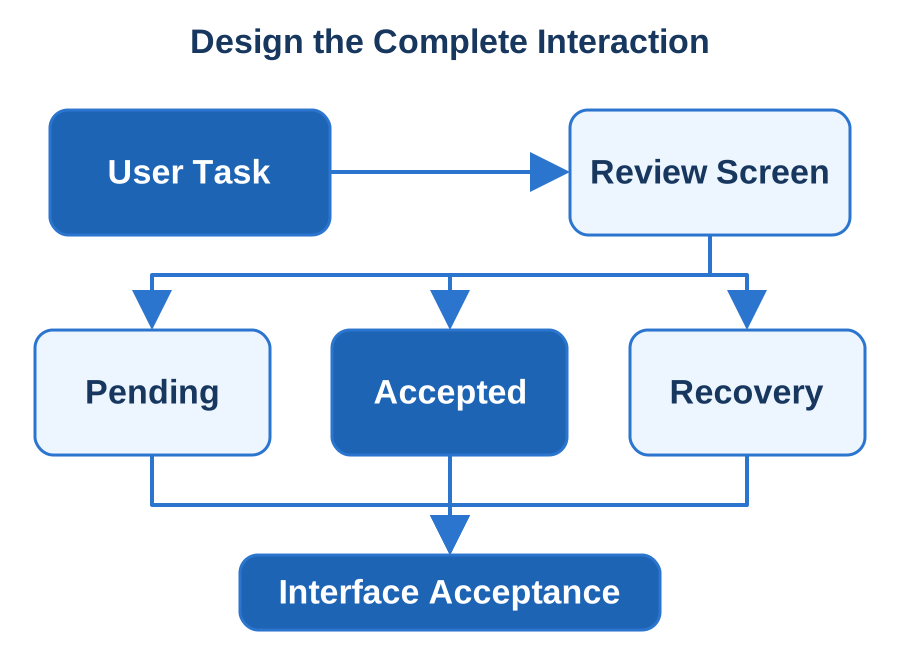
Map the User Journey and Its Decisions
We identify the customer and operator tasks the product must support, then map the information and choices required at each step. A message signature, token approval and asset transfer have different consequences. Their interfaces need accurate language, visible context and an appropriate confirmation step.
We model ordinary business tasks and specialist flows such as a wallet signature or token approval using real records and consequences. Figma journey maps and prototypes expose navigation, account switching, status hierarchy and recovery paths before implementation. Long identifiers, empty states and unavailable data are designed alongside populated screens so the product communicates clearly under the conditions its customers and operators will actually encounter.
Prototype With the Real Application Model
We build wireframes and interactive prototypes for the agreed workflows, supported by a reusable component language. Typography, spacing, controls and feedback work together across the required screen sizes. Component states describe practical behaviour such as validation, disabled actions, copying an identifier and viewing transaction details.
The design system follows the chosen host: Fluent patterns for a Windows product, Material 3 for Android, Apple Human Interface Guidelines for Apple applications, and reusable web components for Blazor or React. Component states map to C# API models and server-enforced permissions. BlockchainSQL Server and Sphere10 Framework application experience inform progress, record inspection and operator controls, while each product receives its own task-specific interaction model.
Validate Understanding, Accessibility and Recovery
We review the prototype using complete tasks: choose the correct account, inspect a record, authorise an operation and determine its outcome. Long addresses, stale data, unavailable networks and conflicting account state are part of that review. The design should help users recognise the situation and select a useful next action.
For web delivery we check relevant WCAG 2.2 criteria through keyboard navigation, visible focus, labels, contrast, text enlargement and error recovery. Native testing uses the platform's accessibility tools, including VoiceOver or TalkBack where applicable. Playwright retains repeatable browser workflow evidence; manual task review checks meaning and usability. A working .NET-backed slice validates uncertain permissions or asynchronous state transitions behind the prototype.
Hand Over a Design the Build Can Follow
The delivery includes journey maps, component states, content and interaction specifications with acceptance examples. We identify reusable assets and record the relationship between prototype screens and implemented features. Developers can see how navigation, validation and asynchronous work should behave, including the states that are easy to omit from a visual mock-up.
Handover supplies Figma components, design tokens, content rules, interaction states and acceptance examples tied to the implemented toolkit. Responsive layouts are reviewed with real copy and records, including validation and pending/error states. We can continue into Blazor, MAUI, Windows or another selected implementation and compare the working result with the accepted journey. Future features then extend a coherent component vocabulary and observable completion criteria.
Technologies & Integration
Discuss Your Project Back to Services
Smart Contract Development
Sphere 10 designs and implements smart contracts for tokens, digital assets, DeFi, governance and business settlement. We build the on-chain rules together with wallets, applications and operational controls, choosing Ethereum-compatible contracts or Polkadot runtime engineering for the actual requirement. Our article What are Smart Contracts? explains the execution model; this offering covers the specific interfaces, permissions, accounting and deployment work needed to turn that model into an operable product.
Delivery spans Solidity, Polkadot SDK Rust and C# integration: token issuance and vesting, escrow and staking, vaults and AMMs, signed authorisations, smart accounts and upgradeable systems. We distinguish a published interface from its implementation and a runtime pallet from a deployed contract. Every release identifies its target network, compiler, authority model and acceptance evidence, with transaction tracking, administration and recovery procedures included rather than left to the surrounding application team.
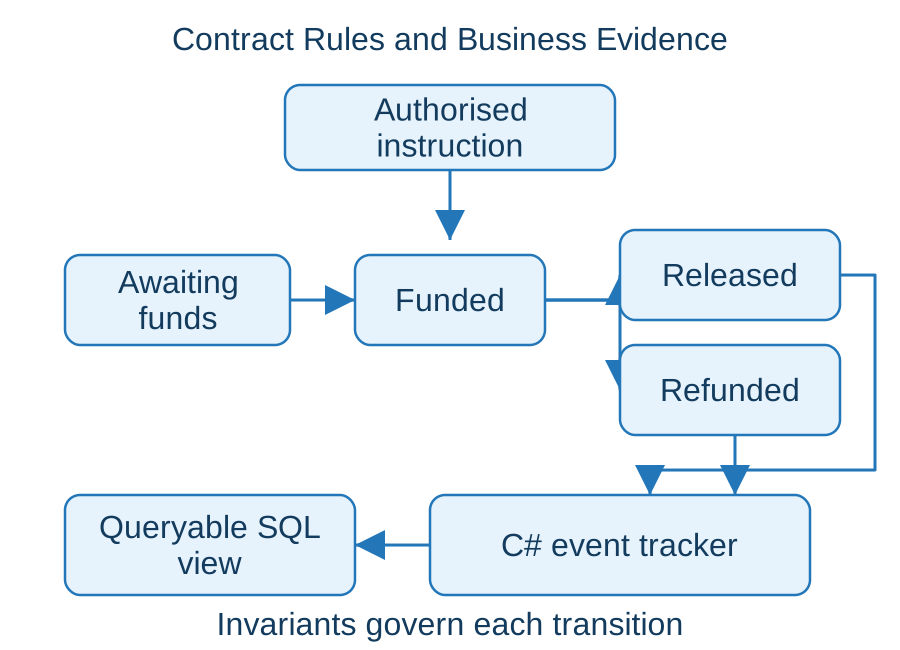
Ethereum Tokens, Vaults and Settlement
We implement ERC-20 fungible assets, ERC-721 unique assets and ERC-1155 multi-token collections, with explicit minting, burning, approvals and transfer policy. ERC-4626 vaults add deposit/share/redemption interfaces, backed by specified custody, fees, rounding and withdrawal liquidity. Asset delivery also covers vesting and escrow, metadata and marketplace settlement; ERC-2981 supplies royalty information whose payment depends on the marketplace. We compose OpenZeppelin components with the required business rules. Existing ERC-777 operator/hook contracts receive compatibility and reentrancy review as a legacy estate, while new token designs select the interfaces their users actually need.
Wallets, Governance and Upgrade Architecture
Signed workflows use EIP-712 structured messages with application-defined nonces, deadlines and domain checks; ERC-2612 permit adds signed ERC-20 approvals, while ERC-1271 supports contract-wallet signature validation. Smart-account delivery can include ERC-4337 UserOperations, bundler integration and paymaster policies, and EIP-7702 delegation on networks that support it. We test the selected wallet and EntryPoint deployment together. Governance, recovery and spending permissions are designed as part of the authority model, not inferred from a connected wallet address.
Polkadot, Substrate and JAM
Polkadot work separates deployed smart contracts from the chain runtime. On Polkadot Hub and compatible targets, we verify the actual pallet-revive backend and toolchain: Solidity can target PolkaVM through resolc, with execution and deployment differences tested explicitly. Custom Substrate/FRAME work builds Rust runtime pallets, storage, dispatchable calls and migrations. Existing ink! estates receive maintenance and migration assessment: its maintainers report active development stopped in January 2026. JAM prototype work targets an identified Gray Paper revision, including service boundaries, refinement and accumulation, with runtime and interoperability assumptions recorded for each experiment.
Test, Integrate and Hand Over
Foundry and Hardhat provide the reproducible unit, fuzz, invariant and integration test harness; Slither adds static-analysis findings for engineering review. We challenge supply, custody and settlement rules across adversarial action sequences. C# services use Nethereum for ABI bindings, signing boundaries, receipts and events, with ASP.NET Core exposing authorised operations. Submission, inclusion and business completion remain distinct, and replayable read models recover from node failures and reorganisations. Our Bitcoin-focused BlockchainSQL work informs that indexing discipline. Delivery includes reproducible builds, deployments, authority registers and operational handover, with specialist findings tracked through remediation and retesting.
Technologies & Integration
Discuss Your Project Back to Services
Blockchain Consulting
Sphere 10 helps organisations turn a blockchain proposal into an implementable decision. We begin with the parties, assets and disagreements the system must handle, then establish whether a shared ledger changes the trust model in a useful way. The review covers transaction authority, participant identity, settlement, privacy and the surrounding business systems. A credible recommendation connects those requirements to a concrete architecture, operating model and cost profile that decision-makers can examine.
We combine protocol-level reasoning with practical .NET application and data engineering. That lets us assess the complete workflow, including wallets, node access, contract administration, event processing and the records your organisation must retain. Our Bitcoin-focused BlockchainSQL product provides an inspectable example of chain ingestion and SQL-facing analysis. We use relevant implementation evidence to shape the proposal, then produce the decisions, prototypes and delivery boundaries needed to move confidently from assessment into a defined build.
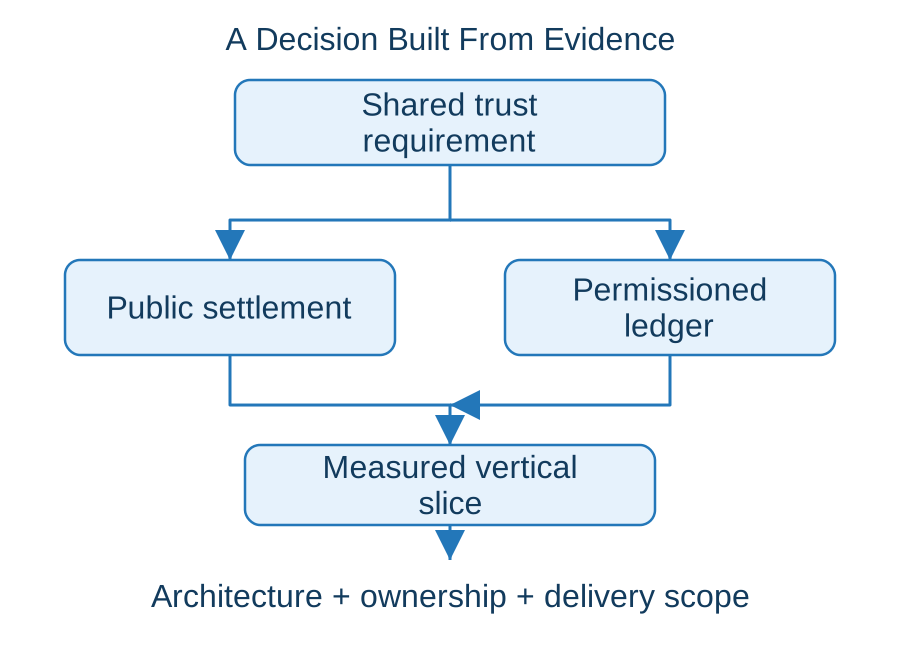
Test the Ledger Proposition Against Real Work
We trace a real transaction from its initiating party to settlement, then map the required authority and verification to a concrete platform. Ethereum or an EVM rollup can provide public settlement; Fabric can coordinate identified organisations through endorsement policies; a Polkadot SDK/FRAME runtime can enforce application-specific state transitions. We compare those designs with a conventional .NET application and signed audit trail using the same privacy, governance and operational requirements. The decision records what should trigger reconsideration as participants or workloads change.
Choose the Network and Governance Together
Network choice includes its actual control model. Arbitrum Nitro and OP Stack designs require sequencer, settlement and withdrawal-path analysis; Besu QBFT requires validator/quorum planning; Fabric requires organisation identities, channels and endorsement rules. Polkadot SDK work separates runtime pallets, governance and XCM configuration from an application contract deployed to a selected VM. We assess administrative keys, upgrades, node access, fees and disruption behaviour against the intended transaction pattern and the organisations responsible for operating it.
Prototype the Hard Integration Boundary
The prototype proves the hardest boundary with its real stack: a C#/Nethereum EVM operation, a Go/Node/Java Fabric Gateway adapter exposed to .NET, a FRAME runtime call or a Bitcoin Core import. We include rejected submission, uncertain response and restart/reconciliation cases. BlockchainSQL Server supplies a Bitcoin-to-SQL reference for source identity, checkpointing and inspectable projections. The result measures the selected integration and updates delivery scope from observed behaviour.
Turn Findings Into a Delivery and Ownership Plan
You receive an architecture and decision record with selected platforms, contract/runtime standards, custody arrangements and explicit unresolved assumptions. The delivery backlog names node configuration, C# APIs, data migrations, signing flows and operator tooling alongside acceptance evidence. We assign hosting, monitoring, upgrades and incident authority, with specialist review inputs where required. The package can progress into an implementation or provide another engineering team with reproducible prototype source, measured findings and a clear operating model.
Technologies & Integration
Discuss Your Project Back to Services
Token Development
Sphere 10 builds tokens with a defined economic purpose, an explicit authority model and the application workflows needed to use them. We develop fungible assets, membership rights, allocation instruments and redemption mechanisms around the actual obligations your organisation intends to represent. The design establishes what a token means, who can issue or retire it, how transfers affect those obligations and which records remain in the business system alongside the contract.
A token launch also needs reliable allocation, administration and reconciliation. We deliver the selected contract or token-program configuration, C# services, operator interfaces and release procedures as one coherent system. ERC-20 provides a recognised EVM interface; Solana token programs and Polkadot assets provide different native models. Supply policy, custody, restrictions and recovery remain deliberate product decisions. We turn those decisions into executable rules and acceptance scenarios, so your team can explain balances, operate privileged functions and maintain the implementation after initial deployment.
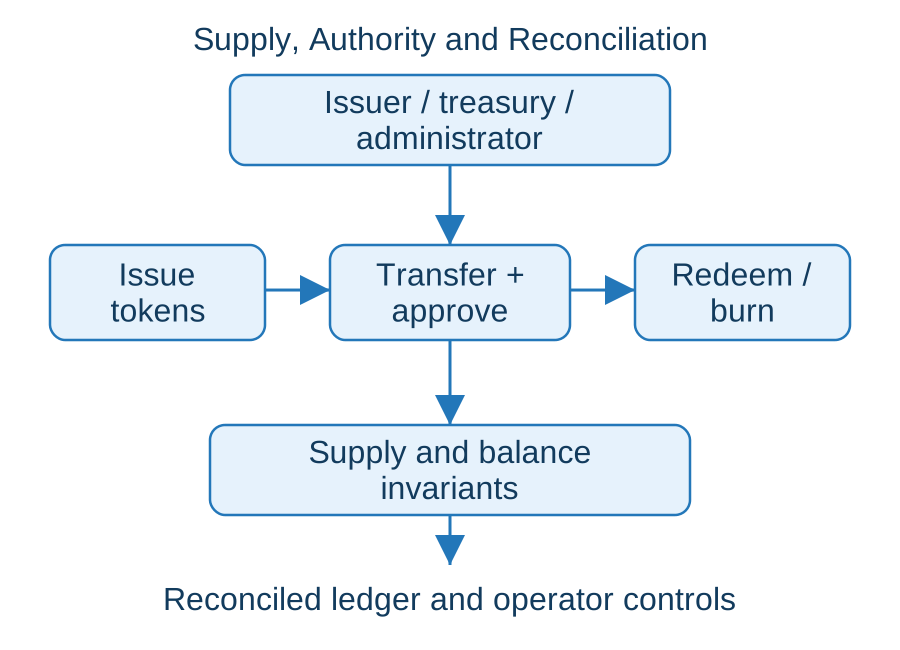
Design Supply and Permission Boundaries
For Ethereum/EVM assets we implement ERC-20 transfers and allowances with selected OpenZeppelin extensions such as ERC-2612 permit, voting checkpoints, caps or pausing. VestingWallet can express timed allocations; a regulated transfer model can use ERC-3643 identity and transfer-policy components when the specification requires them. Solana SPL Token/Token-2022 and Polkadot assets use their own mint or runtime authority models. In every case we define issuance, burn, treasury, freeze and upgrade powers, integer precision and redemption rules before deployment.
Build the Operational Ledger Around the Contract
C# services link allocations, approvals, beneficiaries and business obligations to authoritative token operations. Nethereum handles EVM calls/events; Solana integration uses its token program and account model; a Polkadot asset integration uses the target runtime's metadata and calls. The system distinguishes a requested issuance from a confirmed balance and fulfilled obligation, retaining network, mint/contract/asset identifier and source transaction. Rebuildable projections and reconciliation reports explain outstanding allocations and redemptions; BlockchainSQL provides a Bitcoin-focused reference for that projection discipline.
Prove Token Invariants and Integration Behaviour
Acceptance tests conservation, role enforcement, allowance changes, boundary values and repeated redemption across contract and application layers. For Token-2022 we select extensions before mint creation and test their compatibility with each other and the intended wallets; transfer fees, hooks and non-transferability alter downstream behaviour. Polkadot asset tests exercise issuer, admin and freezer authority as configured. Derived totals are checked against chain state after replay, rejected signatures and interrupted ingestion, with exact integer values retained throughout.
Hand Over a Token Your Team Can Operate
The handover records deployed bytecode/program identity, mint or asset configuration, authorities, opening allocations and the exact standards/extensions implemented. Source, ABI or runtime interface definitions, tests and deployment scripts accompany treasury approvals, key succession, monitoring and reconciliation procedures. EVM upgrades receive storage-layout checks; Solana authority changes and runtime asset administration follow their own tested mechanisms. The release plan can include independent review and specialist legal inputs tied to the actual token obligations and administrative powers.
Technologies & Integration
Discuss Your Project Back to Services
Blockchain Integrations
Sphere 10 connects blockchain networks to the applications, financial records and operational workflows that use their data. We build transaction submission, payment observation, contract event processing, node imports and business-facing APIs with explicit boundaries between the chain and the organisation. The integration identifies which system owns each fact, what confirmation means for the workflow and how the application behaves while network observations are incomplete or change.
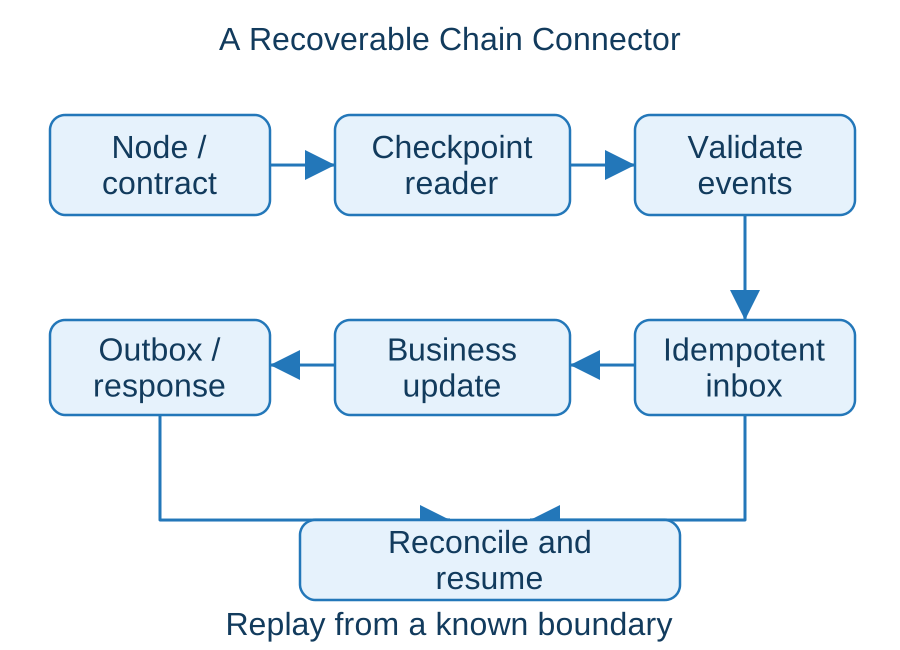
Our implementation treats recovery as a normal operating requirement. C# services retain checkpoints, source identifiers and processing outcomes so imports can resume and messages can be handled again without duplicating a business effect. We develop the connector, persistence model, reconciliation and operator controls together. BlockchainSQL is a concrete reference for Bitcoin data ingestion and SQL-facing projections; EVM integrations use chain-appropriate clients such as Nethereum and preserve their own contract and network semantics throughout the application.
Model the Boundary Between Two Systems
We specify the exact chain interface and the fact it supplies. Ethereum integration uses ABI encoding, JSON-RPC calls, receipts and logs; Bitcoin Core supplies transaction/block and UTXO observations; Polkadot uses runtime metadata, SCALE-encoded calls and storage; Solana uses program accounts, transaction signatures and commitment levels. Each adapter retains network, account, units and business correlation identity. Submission, inclusion, finality and application completion become explicit states, with signing authority and permitted operations defined at that boundary.
Implement Durable Ingestion and Reconciliation
Nethereum block/log processors support checkpointed EVM ingestion; we commit stable event identities and processing outcomes with the local business update where appropriate. Bitcoin reads retain block hashes as well as heights, while Polkadot decoders follow the selected runtime metadata and version. An outbox records outbound intent before external work. Bounded retries, cursor persistence and chain-specific rewind/reconciliation rules let the connector resume without duplicating an allocation or payment effect, with external waits outside long database transactions.
Diagram source
flowchart TD
  W["Wallet or multisig"] -->|Sign| C["Contract or runtime call"]
  C --> N["EVM or Polkadot node"]
  N --> I["Event indexer"]
  I --> F{"Confirmation policy met?"}
  F -->|Wait| I
  F -->|Yes| B["C# reconciliation service"]
  B --> D["SQL business records"]
  N -. Reorganisation .-> I
classDef default fill:#eaf2ff,stroke:#2f77cb,color:#17365d,stroke-width:1.5pxConnect Chain Data to Useful Application Interfaces
ASP.NET Core exposes application-authorised commands, payment status and reconciliation queries over the connector's durable state. BlockchainSQL Server illustrates Bitcoin parsing, transformation and an inspectable SQL-facing model. Solana account/event projections and Polkadot storage/extrinsic views receive their own source identifiers and confirmation policy. XCM or another cross-chain integration additionally tracks message routing, execution and acknowledgement outcomes. OpenTelemetry traces and metrics connect the business operation to node calls and processing checkpoints for investigation.
Accept Recovery as Part of the Delivered Feature
Acceptance stops nodes, interrupts imports and repeats observations against a recorded source range. We exercise EVM reorganisations, selected Bitcoin confirmation/rewind policy, Solana commitment progression or Polkadot runtime changes as applicable. Transaction replacement, expired submissions and lost responses are reconciled before another action is issued. Delivery includes adapters, schema/version contracts, fixtures, monitoring and recovery runbooks; operators can explain totals after replay and trace a failed operation to its authoritative chain evidence.
Technologies & Integration
Discuss Your Project Back to Services
Cryptographic Analysis
Sphere 10 analyses cryptographic designs at the point where algorithms, data formats, keys and application behaviour meet. We review signing, authenticated encryption, hashing, key derivation and integrity constructions against a defined threat model and the actual protocol using them. The work covers both new designs and existing systems that need interoperability, migration or a clear explanation of their cryptographic assumptions before further development.
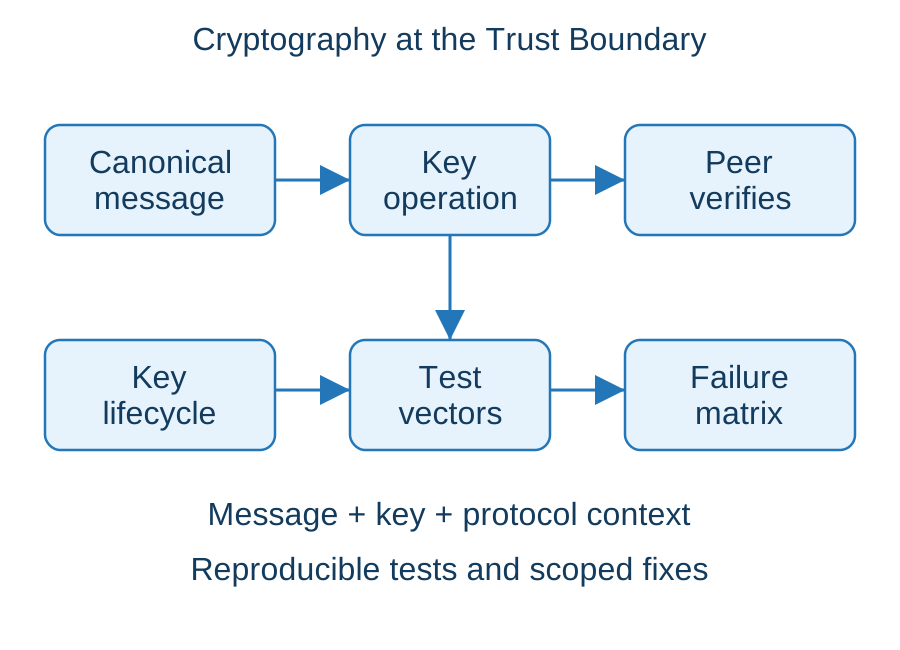
Our approach combines mathematical and protocol reasoning with executable C# tests and concrete implementation inspection. We identify exactly which bytes are authenticated, how keys are created and stored, which context prevents messages being reused incorrectly and what the recipient rejects. We use established primitives and published test vectors, then examine how they are composed in your system. You receive reproducible findings, scoped implementation corrections and verification artefacts that connect each conclusion to an observable behaviour or explicit assumption.
Trace the Construction From Input to Verification
We specify the exact bytes passing through canonicalisation, encoding, hashing, signatures or authenticated encryption. For a blockchain signature this includes curve, digest, chain/domain context and signature encoding; for a service message it includes field boundaries, protocol version and replay state. SHA-256, SHA-3 and Keccak-based formats are selected according to the protocol's actual definition. Malformed lengths, ambiguous encodings and altered recipient/context fields become executable rejection cases, so verification is tested against the construction the application really uses.
Review Keys, Randomness and Established Primitives
The review covers AES-GCM nonce/tag handling, HKDF extract-and-expand context, and signature schemes such as Ed25519 or protocol-required ECDSA/secp256k1. We inspect key generation, custody, rotation, retirement and library configuration together. In Sphere10 .NET applications, established Framework cryptographic abstractions provide the integration boundary, with compatible vetted implementations selected for the required scheme. The application owns key purpose, authenticated context and permissions, while implementation review checks errors and secret lifetimes at each call.
Build Interoperability and Adversarial Test Evidence
Known-answer vectors and cross-implementation fixtures verify messages versus digests, byte order, signature representation and invalid inputs. Merkle proof tests fix leaf encoding, node order and tree shape. For post-quantum migration work we assess ML-KEM key establishment under FIPS 203, ML-DSA signatures under FIPS 204 or SLH-DSA signatures under FIPS 205, checking implementation availability, parameter sets and protocol compatibility. Timing or other side-channel assessment receives a defined measurement scope tied to the threat model.
Deliver Findings That Can Be Implemented and Closed
Each finding records the affected construction, prerequisites, reproduced behaviour and correction with retest evidence. Migration plans cover key/format versions, stored ciphertext or signatures, peer compatibility and transition rules; cryptographic agility is implemented as explicit protocol negotiation and version policy. Handover contains the construction specification, vectors, test harness and key-management operating notes. Standard conformance and any required validated-module deployment are assessed for the exact implementation and environment within the agreed scope.
Technologies & Integration
Discuss Your Project Back to Services